The carpet of fate: irony and drama
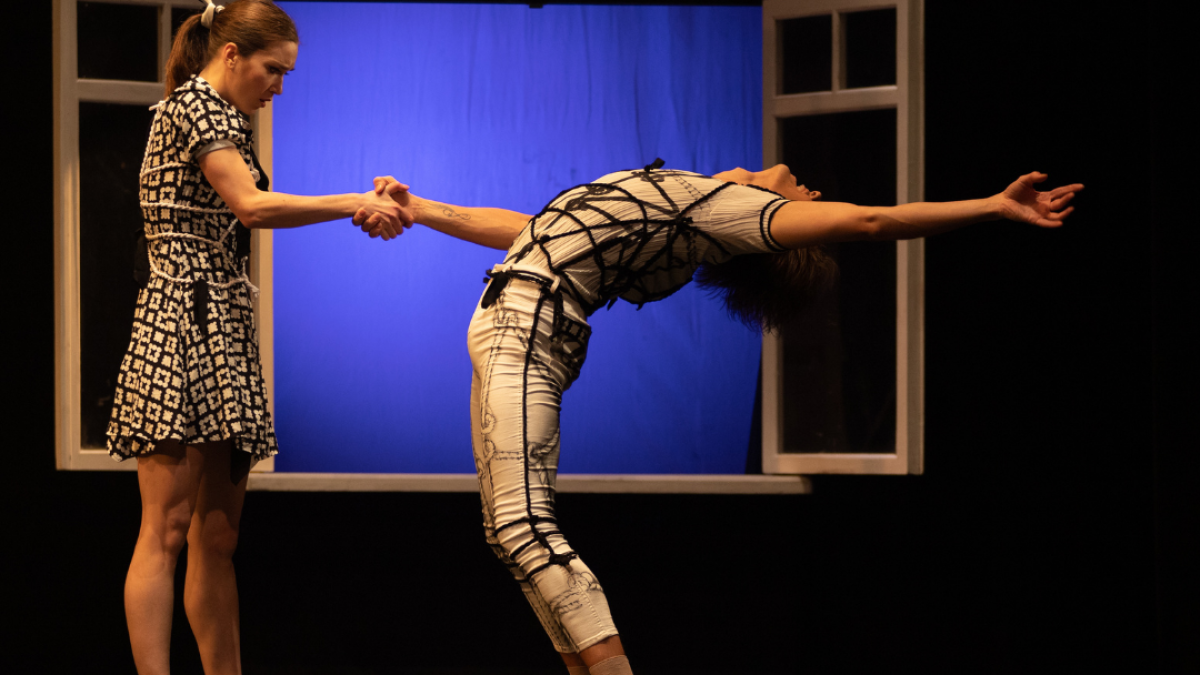
Radu Poklitaru staged a new one-act performance “Nine Dates” to the romantic music of Frédéric Chopin. And alongside it — by contrast — another one-act ballet titled “In pivo veritas”. This ironic performance — a paraphrase of the famous ancient saying “In wine, truth” — Poklitaru staged many years ago to traditional Irish music.
Radu Poklitaru has staged a new one-act production, «Nine Dates», set to the romantic music of Frédéric Chopin. And alongside it – by way of contrast – another one-act ballet titled «In pivo veritas». This ironic piece – a paraphrase on the theme of the famous ancient saying «In vino veritas» – Poklitaru staged many years ago to traditional Irish music. On the whole it came together, as it always does with Poklitaru – irony alongside drama, sorrow and laughter. As is so often the case in our lives, too.
SORROW AND LAUGHTER
In the first part of the evening beer truly flows like a river, yet before the party begins an old descendant of the Celts, resembling Don Quixote, attempts to display his warlike spirit. Unable to handle his sword because of the beer he has drunk, he falls asleep for a long while with his face on the table, no longer paying any attention to the dances of the lively young couples. Perhaps a quarter of a century ago, when, thanks to «Riverdance» and other similar shows, Irish performers came into fashion, Poklitaru wanted to create his own version of these fiery dances. But he did not set out to achieve the synchronized rapid footwork that still sends audiences into raptures; instead he created little scenes – sketches, sometimes amusing, sometimes lyrical, that signify anything you like except a threat with a sword. Indeed, the moment the young men put on their short checked skirts (kilts) and set off dancing with their partners, they no longer look like warriors. And the beer very aptly fuels the amorous passions and puts everyone in a peaceful mood. Thus Radu Poklitaru confirms his unique ability to create «meaningful choreography», even when the backdrop for it consists of spirited dance tunes.
Among the absence of any taboos and the presence of Poklitaru’s «signature» devices I would also include the costume of the lead soloist, who wears a pointe shoe on one foot, while the other remains bare, save for a flowery woollen legwarmer. This absence of symmetry and of the «obligatory» conditions for the paradoxical style of dance I would, in general, count among the hallmarks of the creative work of our leading choreographer, who continues to astonish in every new piece. And, as a rule, to irritate the advocates of common sense in ballet, where, properly speaking, it has no place to begin with.
Another typical feature of Poklitaru as a director is the principle of «rejection», which helps to rid the work of clichés, standard devices and already well-worn interpretations. That is precisely why his artistic solutions look fresh and contemporary. This, incidentally, was something the French poet Paul Valéry spoke of as well: «An artist should reject the first thing that comes to mind, and move further away from everyday associations».
PAST, FUTURE AND PRESENT ARE WHIMSICALLY INTERMINGLED
In the ballet «Nine Dates» Poklitaru turned to the work of Chopin, mindful, of course, that before him there had been Mikhail Fokine’s «Chopiniana», and Anna Pavlova’s «Autumn Leaves», and Jerome Robbins’ ballet «In the Night», and José Limón’s piece in memory of Isadora Duncan – all of them, and many others, were inspired by the music of the great romantic, the poet of the piano. As one of his «comrades-in-arms» Radu also took one of the most brilliant pianists of our time, Grigory Sokolov, whom Ukrainian listeners came to know after his triumphant victory at the Tchaikovsky Competition in 1966. Since then he has become not merely a maestro, but a perfectionist who treats music as an artistic cult. G. Sokolov fills concert halls to capacity in any country, and the recording of his performance of Chopin’s preludes, written in 1836–1839, that was heard in the production is indeed full of artistic revelations, which were reflected in the choreographic score as well. Chopin’s preludes are, in general, a wonderful occasion to recall the composer’s dramatic biography, his affair with George Sand, the «aphoristic» quality of the images in each of the 24 preludes of the cycle (the choreographer used nine of them, the ones most important for his own interpretation).
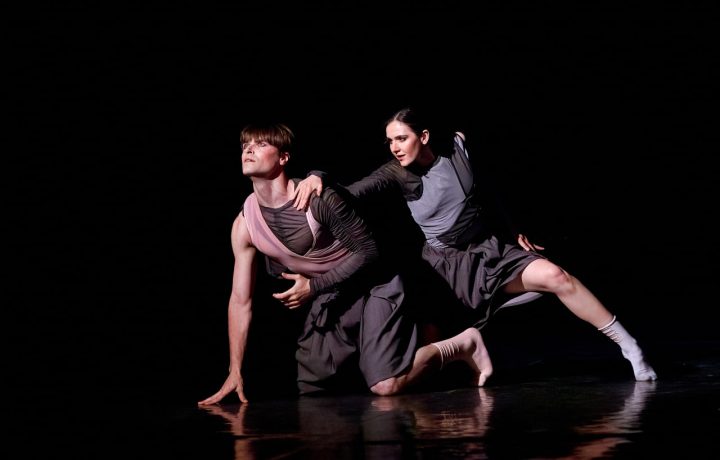
The story of two lovers (played and danced by the «Kyiv Modern Ballet» company’s principals Olena Saltykova and Artem Shoshyn) is told by Poklitaru not in the traditional narrative manner, but as if through the stages of their shared fate, emotionally prompted by the music and its semantic accents. At times the past, the future and the present are whimsically intermingled. These are not merely romantic surges of a relationship, but sensual, even frankly sexual scenes, dramatic fragments of quarrels and instances of black humour or of a not entirely decent anecdote, which are worth seeing but pointless to retell out of context. All the more so since Vladyslav Detiuchenko, the performer of the provocative role of «the odd one out», presents his character with grotesquerie and self-irony.
Poklitaru is a master of theatricalizing choreographic action: amid Chopin’s chords, the sound of a door closing, the drumming of fingers on a table, a guttural cry of despair, the sense of the heaviness of physical coexistence (incredibly, the fragile dancer really does drag her partner along on herself) all become apt. Of course, absorbed spectators forget that the ballet was prepared during the lockdown – there is not the slightest trace of any mental sluggishness; the energy of the performers, embodied through the director’s charisma, brims over. And it has been so for almost 15 years now, the years that have passed since the birth of Poklitaru’s «Kyiv Modern Ballet». In due course the process of a changing of the generations is under way. And the company’s «godfather», the patron Volodymyr Filipov, has once again returned to help it in a difficult year. Wonderful and symbolic!
One of the production’s greatest triumphs is the duet set to the music of the minor-key prelude, resembling a funeral march. Taut ropes hold the lovers back, keeping them from uniting at the centre of the stage. And these are not conventional ballet movements, but a physical, real and emotionally charged action. And throughout this whole process some strange old woman constantly looks on, mutters something and hobbles along the front of the stage, resembling now the Fairy Carabosse, now the spider Arachne, or the goddess of fate, a Parca, with a ball of yarn on her head (she is talentedly embodied by Anastasiia Dobrovolska). As in the previous ballet (remember the Celt tipsy on beer), with her help Radu Vitaliyovych once again wanted to give us an additional hint at something important. And after the premiere he even held an intellectual quiz with the guests: guess who this strange person is? The winner, of course, was the one who came up with this visible image, the production’s set designer Hanna Ipatieva. It was she who suggested that this is what the ballet’s heroine might be like in old age: for we ourselves, with the help of all the forces of the universe and the peculiarities of our own will, weave the pattern of the carpet of our own fate.
Oleksandr CHEPALOV, Honoured Artist of Ukraine
The newspaper Den’
No. 17, (2021) Section: Culture