To kill or to love? “Viy” by Radu Poklitaru and Kyiv Modern Ballet
Every premiere of a Radu Poklitaru ballet in Kyiv is a long-awaited event!
Every premiere of a Radu Poklitaru ballet in Kyiv is a long-awaited event! Tickets are bought in advance, outfits are chosen, behind-the-scenes rumours are gathered together — in short, it is a sensation. And that is no surprise, for the Kyiv Modern Ballet theatre is one of the few that is engaged in contemporary art.
Let us talk about the ballet “Viy”, whose premiere took place this June and which a few days ago once again delighted the eyes and ears of Kyiv’s balletomanes. Here you will find all the components of a successful marketing move. First, the very title, which has already become immortal and is always in demand. After all, Mykola Hohol’s mystical tale is fertile ground for experiments and modifications. Second, choreographer Radu Poklitaru, who is unquestionably a favourite of Ukraine’s theatregoers. Third — this is the first ballet on a Ukrainian theme in the artist’s body of work. This immediately forced the KMB theatre’s opponents to reconsider their grievances about Poklitaru’s repertoire policy. Another important element was the collaboration with contemporary Ukrainian composer Oleksandr Rodin, who wrote the music for the ballet specially.
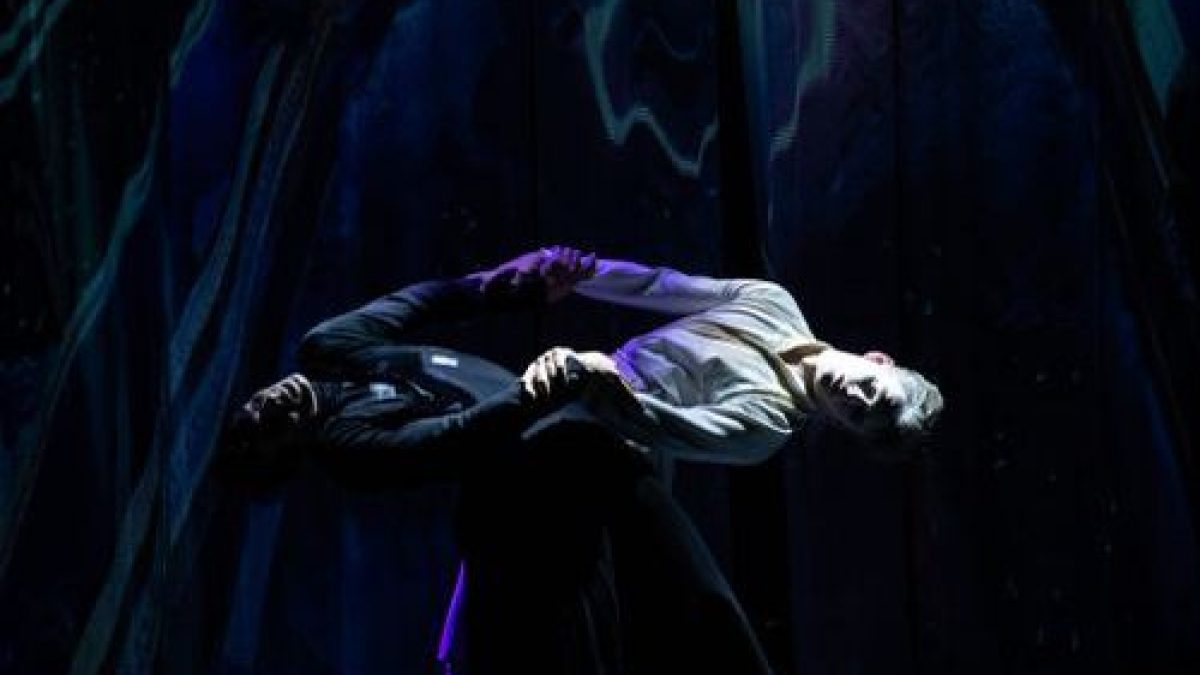
But the most important breakthrough of this production was the use of video content, developed by Olha Nikitina. Indeed, for the Ukrainian audience of contemporary, and especially of classical, ballets — accustomed to seeing old sets that are banal from a technical point of view, and at times rickety and half-ruined — virtual sets were perceived as something out of science fiction. In truth, however, such enraptured perception is rather sad, for it testifies to a certain backwardness of the Ukrainian theatrical process. It is well known that the world’s theatres have long been incorporating video content into their stage design, and this is regarded as an ordinary working matter. But the first step has been taken, and that is wonderful; let us hope it will be possible to get things moving off dead centre.
Theatrical maniacs are always drawn to Poklitaru’s productions by their unconventional approaches to familiar things. And this time, too, the ballet master did not disappoint the audience. He revealed new, philosophical facets in Hohol’s famous novella.
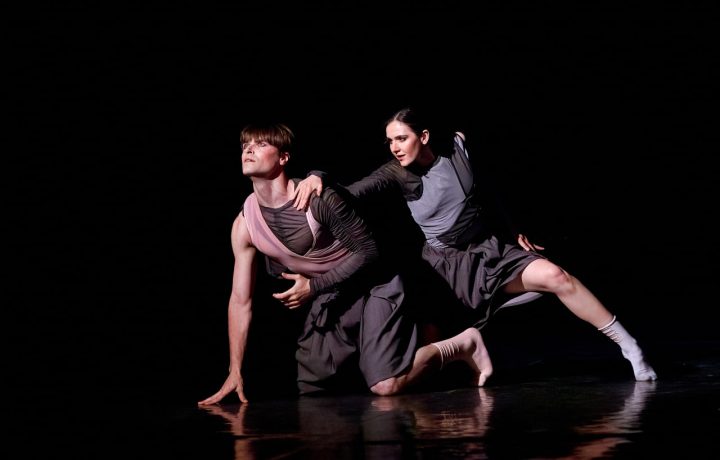
Khoma Brut (Vladyslav Detiuchenko) is a typical young man dissatisfied with his own life. His studies, which were most likely chosen for him by his parents, bring him no satisfaction whatsoever. And that is frightening, for Khoma is a future healer of human souls — a clergyman. Instead of a deep awareness of important truths, he is frankly bored in the company of seminarians like himself. His surroundings underscore the wretchedness of his life. He has no real friends, and those whom he considers such have no appropriate life priorities. In the ballet version, Khoma acquires a girlfriend — Vasylyna (Kateryna Kuznetsova). It is no accident that she bears such a name — the connection with the serpentine monster, the Basilisk, is obvious. At first glance, she is a shy girl who even flees Khoma’s excessive bodily desires. But her essence is revealed in small details — a craving for fame, a striving to be the centre of attention (and Khoma is a fine-looking lad!), a passion for alcohol and nightlife, money-mania of course, debauchery, and that is far from a complete list.
Such a life does not suit Khoma, and so he strives to change his reality. This is achieved by various means. At the start of the ballet he takes pills of “happiness”, which allowed him to fly off into a new reality with nymphs who, every one of them, crave his body. Then he consumes a great deal of alcohol, and it is precisely in this state that he meets the Lady (Olena Saltykova). Who is she? A VIP girl, a prostitute, a priestess, or a mirage of the woman of his dreams (she is the complete opposite of all the women in the ballet)? After all, everything that happened next may be either reality or alcoholic hallucinations that drove Khoma to his death.
The audience first sees the Lady in an erotic scene with the Centurion (Artem Shoshyn). And once again the question arises — what is this? Incest, the sexual dreams of the Centurion or the Lady, or perhaps the erotic fantasy of some third party, Viy for instance?
In general, Viy’s role in this ballet is philosophical and mystical. No, he is not a separate character; he is one of the Centurion’s three guises. The Centurion is presented in the production as a threefold evil: a stern and indifferent teacher at the seminary, instead of a revered father confessor; a sexual daddy-guru, instead of a loving father; and Viy, who took Khoma’s soul in a demonic manner. Such an interpretation of the Centurion’s image raises not only artistic but also social problems of humankind.
So what happened during those three fateful nights in the church, where Khoma’s soul (Illia Miroshnichenko) struggles — not against evil, but against temptation? And did these nights actually take place? Of course, the audience is shown them as separate real days, but there are several “buts”… Indeed, already after the first night the audience sees a funeral table that grows into a frenzied orgy. On the second day, two friends come to Khoma who do not support him but only drive him deeper into a depressive state.
In the ballet Viy, Radu Poklitaru reveals profound philosophical questions of life’s despair through scenes of killing. First Khoma kills the Lady, thereby killing his image of the ideal woman, and at the end of the ballet Khoma commits suicide, consciously surrendering to all temptations.
To kill or to love? The ballet will answer!
Veronika ZINCHENKO
In detail: Moderato.in.ua