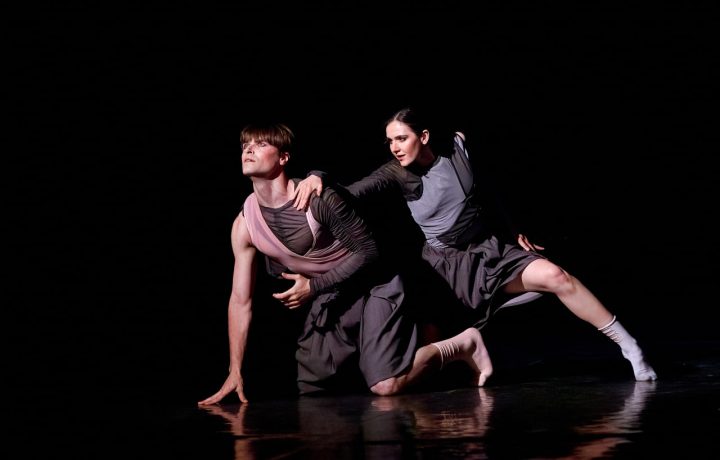
A church of the soul’s demons. Premiere of the ballet “Viy” by Kyiv Modern Ballet
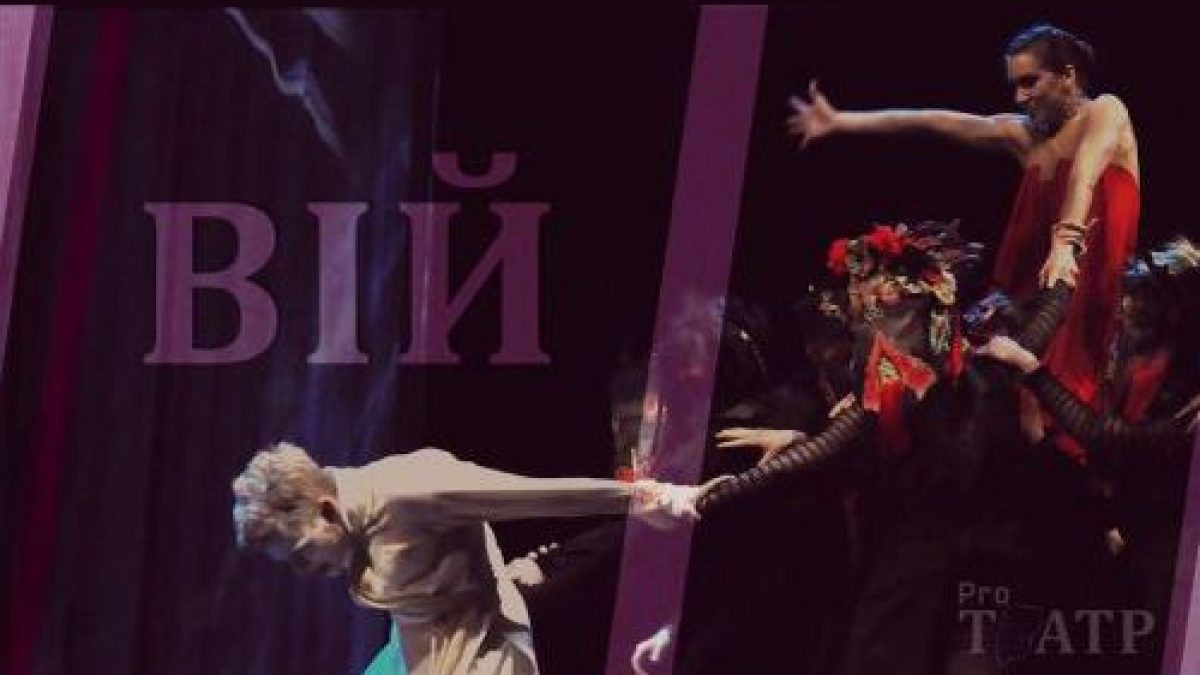
The tailor of choreographic fabric Radu Poklitaru, together with contemporary Ukrainian composer Oleksandr Rodin, gave Ukraine a new premiere — the ballet “Viy”.
The tailor of choreographic fabric Radu Poklitaru, together with the contemporary Ukrainian composer Oleksandr Rodin, has given Ukraine a new premiere — the ballet «Viy» based on the eponymous work by Nikolai Gogol, performed by «Kyiv MODERN-BALLET». For the first time, the director-choreographer sets out on stage to unravel a Ukrainian myth by a Ukrainian writer, and instead extracts from this work, familiar from the school curriculum, a universal cosmological parable. Oleksandr Rodin, for his part, creates a distinctive musical canvas that, with its seemingly mystical harmony, leads us beyond those frontiers of our universe that we are unable to grasp on our own. Rodin’s music becomes a kind of fifth sense for the viewer, revealing the hidden Gogolian essence.
The interpretation imposed by the well-known screen adaptation of the work, with Leonid Kuravlyov and Natalya Varley, deeply imprinted «Viy» as the first Soviet horror story. A sort of fairy tale about the frivolous seminarian-Little Russian Khoma, who suffered because of his insolence and short-sightedness from the spells of the witch-young lady. Yet neither at school nor in the film interpretation was it explained why Khoma must bear his punishment. Simply because the witch, the a priori embodiment of evil, is doing her traditional black, dirty work, like all the unclean spirits under her command? But is that not too simple and banal for so exceptional a creative literary personality as Nikolai Gogol? It was precisely such questions that remained unanswered for me personally, until my philological fate compelled me to delve into the numerous scholarly visions of the Ukrainian writer’s work.
He was the son of an equally talented father, Vasyl Gogol, who wrote plays in Ukrainian for the theatre of Dmytro Troshchynskyi, in which he himself also acted. From childhood Nikolai was nurtured in an atmosphere of creativity and a remarkable depth of folk lore, which his father passed on to him through his works — works that would later become the primary source of Nikolai Gogol’s famous stories about the magical land of Poltava region. So is the horror fairy tale «Viy» merely an interpretation of those same paternal folk legends? Far from it!
In his production, Radu Poklitaru turns to Gogol as the greatest Ukrainian mystifier, a dark genius, a skilful psychoanalyst and philosopher who, like Carl Jung, looks at the world through the prism of psychological demons and mythological archetypes. Viy, of course, is not literally the old man with extremely long eyelashes from folk poetry, whose task is to terrify the weak and the insecure; it is not even the historical Cuman khan Bonyak, who according to legend could destroy an entire city with a single glance; it is not even the Scythian god of death and the dark beyond. For Gogol and Radu Poklitaru it is the quintessence of universal evil, sin and vice, which dwells inside each of us and gathers its forces at the slightest opportunity, whenever the soul yields to the dark forces.
The director-producer, together with the costume designer Dmytro Kuriata, who created the universal visual code of the characters, do not speculate on the theme of the work’s Ukrainian folk character (a literal interpretation of the folk costume); instead they present a timeless and territory-less myth about the human soul through contemporary costumes that play on the contrast of basic symbolic colours: black, red, white. Poklitaru treats the text itself with all responsibility and tact, becoming not a re-cutter of the perfect but a co-author — an equal among equals. Even the new character introduced by the choreographer — Khoma’s girlfriend — only reinforces the binary antithesis of good and evil, light and dark. By contrasting the Young Lady (Olena Saltykova) and Vasylyna, he underscores Gogol’s intention. Brutal advances drive Khoma’s girlfriend away from him, yet without a drop of sorrow he immediately accepts the advances of the Young Lady, who, as in Gogol, will soon «saddle» him, subdue him, destroy him.... But will she destroy him completely?
Khoma is a reveller, an irresponsible and superficial seminarian, like most of his fellows. Vladyslav Detiuchenko, in his choreographic drawing, pointedly demonstrates his deliberate prayerful poses during his studies, which testifies that every prayer is merely a forced convention of seminary learning when it is not backed by the work of the soul. The compassion of those seminarians — the 12 apostles — before they send Khoma off to be culled, as if to the block, also looks feigned, for one does not ache over what does not concern oneself. For the first time in his production, Radu Poklitaru uses 3D video mapping, created by Olha Nikitina, which becomes not merely the dominant of the scenography but a fully fledged living character. The viewer finds himself beyond the material world and observes a weak human being driven by the Hand of an invisible force, turning Khoma into a controlled marionette.
Viy is the physical manifestation of sin, and Khoma has a whole array of them: drunkenness, fornication, vanity and, ultimately, the desire for easy gain and the money flying from the hands of the Centurion as payment for the work to come. «People perish for metal…» — as Mephistopheles sang in his couplets in Gounod’s opera «Faust». Here, as in Goethe’s classic plot, the struggle for the soul is one of life and death. Only here it is Viy, who lives in the darkest corners of the soul, who calls the tune. Artem Shoshyn, who embodies the images of both the Centurion and Viy himself, inscribes through his choreographic drawing the very character inherent to a man in a black military tunic — he is distinguished from the other characters by precise movements with a certain measure of academism. Evil always calculates everything with officer-like accuracy. He and she, the Young Lady, are lovers of evil; it is not for nothing that they merge in lovemaking, and the Young Lady, accepting an ornamental collar from Viy’s hands, becomes his faithful servant.
A lost soul, such as Khoma’s, has a right to forgiveness, the director argues. That is why the entire mise-en-scène of the witch’s funeral rite is a confrontation of the seminarian’s bright «Self», who comes out of his body in spirit to do battle with his own demons. And this is where prayer is no longer merely a text but a right to salvation, a weapon of light. And even if death must come, it will be only a physical death, while the soul is able to ascend upward along the heavenly stairs. It is precisely through this coda that Radu Poklitaru acts as a kind of advocate for Khoma, leaving him a chance to be cleansed, for, as Jonathan Swift said: «To rise to heaven — that is the work! To rise to heaven — that is the toil». And indeed Khoma made every effort to kill the Viy within himself, thereby earning the «light».
Once again Radu Poklitaru erases the boundaries of hackneyed stereotypes and conventions; for him there are no rules or borders when it comes to the creation of art, when, thanks to the birth of Oleksandr Rodin’s new musical canvas, Gogol’s story comes to life on the ballet stage.
Review: Dasha KASHPERSKA
In detail: PRO Teatr