A theatre of chimeras
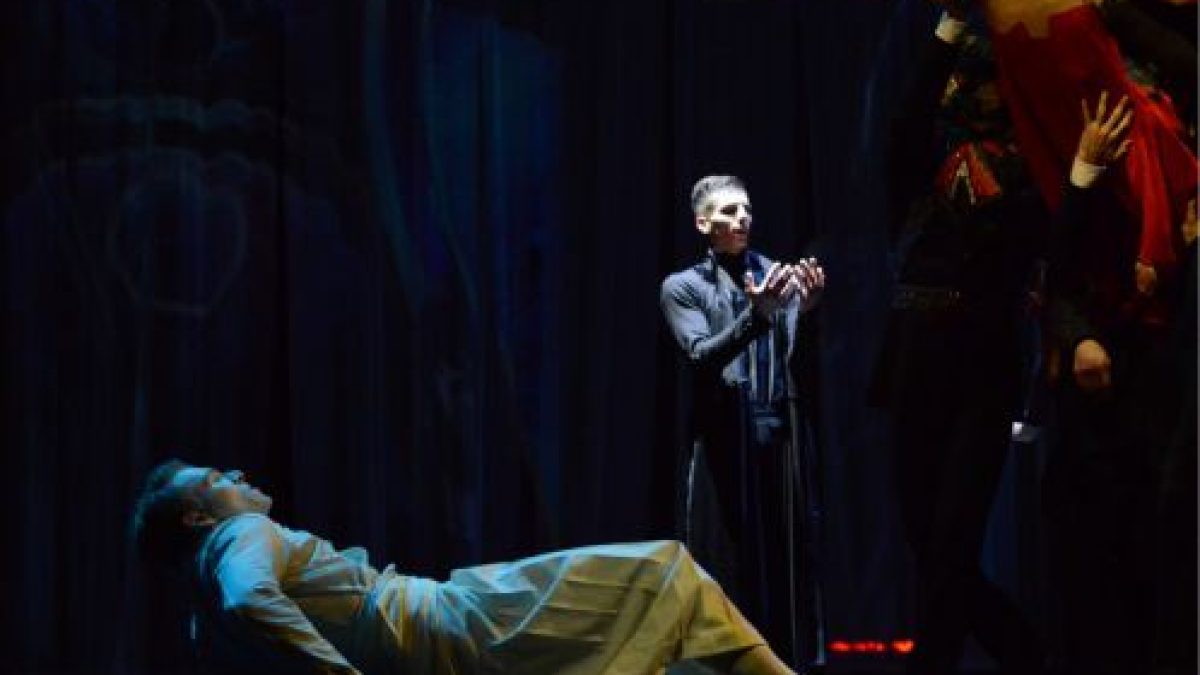
On June 20, at the International Centre of Culture and Arts (October Palace), Radu Poklitaru’s author theatre “Kyiv Modern Ballet” performed the ballet “Viy” based on the novella by Nikolai Gogol.
On the last page of the programme, the audience could see a montage of two portraits of "twin brothers": choreographer Radu Poklitaru and composer Oleksandr Rodin, who are almost the same age. In real life you would hardly mistake one for the other, but here, in the composite photograph, the resemblance is striking: shaved heads, beards, slightly demonic gazes turned downward and never meeting. And even though in the new production of Kyiv Modern Ballet Poklitaru and Rodin are not rivals but co-creators, their partnership nonetheless mirrors that very antagonism of the real and the virtual that still makes us shudder at the name of the gnome chieftain with eyelids drooping to the ground, and fill theatre halls in order to see something that will let us understand ourselves better.
Only someone who read Gogol a very long time ago could think that Radu Poklitaru simply adapted a textbook plot to the structure of a two-act ballet. In fact, as in all his previous stagings of the classics, he preserved its spirit but not its letter — its conflict, if one may put it that way. He made it more real and even more social, where personal relationships are always overlaid with belonging to contemporary hybrid "classes," each of which is a kind of otherworld to the other.
Costume designer Dmytro Kuriata created truly Gogolian attire: a band of seminarians and divinity students, at the centre of which is the philosopher-protagonist Khoma Brut (Vladyslav Detiuchenko), and his two daredevil comrades — the theologian Khaliava (Andrii Chaplyk) and the rhetorician Tiberii Horobets (Dmytro Kondratiuk), dressed in long dark frock coats ("po sie vremia: slovo tekhnicheskoye, oznachavsheye — daleye pyatok").
Khoma’s girl Vasylyna (Kateryna Hloba) belongs to the same company, and their relationship is rather playfully friendly (in Gogol this incidental character appears only after Khoma’s first night in the church, when he tries to find out what fabric her blouse and skirt are made of and gets a spade across his back in reply).
Yet Radu reworked even more substantially the storyline of the old Cossack Sotnyk (Artem Shoshyn) and his daughter — the beautiful witch Pannochka (Olena Saltykova), and along with them Viy and his numerous retinue. In the ballet they are lovers from either a higher or an otherworldly realm, an intrusion into which costs Khoma his very life. This world is bright red in colour, incredibly erotic (both Sotnyk and Pannochka dance half-naked), capable of seducing not only the naïve Brut but the entire crowd of divinity students, who in the second act exchange their human faces for hideous masks and cross over to the dark side. Where, by the way, there are two chieftains: the entirely real Sotnyk and the "shadow" Viy, from whose eye sockets Pannochka slowly draws two red strips of fabric — those bloody tears she herself weeps in the coffin in Gogol’s tale.
This production has no set designer and no traditional stage design as such. There are only some sizeable suitcases at which the students study, drink and sing songs. And above all — a huge cube in the middle of the stage, onto which Olha Nikitina’s three-dimensional video sequence is projected. That virtual reality, the "aquarium" in which Khoma Brut observes his erotic dreams, is ideal material for contemporary ballet. (After all, what is Gogol’s scene with the witch who mounts Brut, and at the end of their shared flight turns into a beautiful young lady, if not a sexual act, along with all those piercingly sweet sensations that Khoma cannot explain to himself? And even after the first night in the church, Khoma still keeps thinking that all the nocturnal events were merely a dream.)
And one more thing we observe from time to time in the video projection — a virtual hand that now flings the characters into the "cubic" parallel reality, now yanks them out of it, once again raising the question of the limits and freedom of our choice.
Why Radu’s choice fell precisely on composer Oleksandr Rodin is easy to explain. The collaboration of the now 44-year-old composer with Kyiv Modern Ballet began with the production "The Spectre of the Rose." It was staged in 2014 by Oleksii Busko, a protégé of Poklitaru’s theatre, on the stage of Kyiv’s Municipal Opera for Children and Youth — and formally it is a production of that very theatre, the Municipal Opera. Two years ago, in April 2017, Radu presented the premiere of the ballet "Up the River." It is based on Fitzgerald’s "The Curious Case of Benjamin Button," but, as always, transformed, with music for string quartet by Oleksandr Rodin.
This time Rodin wrote a large two-act ballet for symphony orchestra with additional percussion. And it must be said that scores like this, which take months of painstaking work to create, are now a great rarity. This music has carefully drawn characters, strong emotions, and the ability to don the mask of a Romantic composer from time to time while remaining on the contemporary wavelength, keeping fully in step with what Radu Poklitaru is doing on his part of the field. Fortunately, neither the one nor the other has to compete here with a classic — a canonical ballet version of "Viy" simply does not exist. Or rather — did not exist until now.
Now we have it.
Yulia Bentia
In detail: ZN.UA, 26 June