Radu Poklitaru — who is he, “Viy”?
Six evenings at the Odesa Opera Theatre and six unforgettable ballet performances — from July 4 to 9, 2019, for the 5th year in a row the “Kyiv Modern Ballet” theatre, led by Radu Poklitaru, holds its author festival “Summer in Modern Style”…
Six evenings at the Odesa Opera Theatre and six unforgettable ballet performances – from 4 to 9 July 2019, for the fifth year in a row, the Kyiv Modern Ballet theatre under the direction of Radu Poklitaru is holding its own festival, «Summer in the Modern Style». In addition to its striking and already well-known ballets, the festival will present a new premiere staged after Gogol’s novella «VIY», which had been performed to great success in Kyiv shortly before.
Viy without Viy
On a scorching summer’s day, the theatre begins not with an empty coat rack… but with the programme! The principal mystical character who gave his name to Gogol’s novella and, accordingly, to Radu Poklitaru’s new ballet – «VIY» – did not appear in the Kyiv Modern Ballet premiere programme. That’s right, he did not appear – at all! Nowhere. His disappearance was the first mystical intrigue – and in real life, too. That is, even before the action began on stage. The programme in my hands attested that the rest of Gogol’s characters remained plainly present on paper. The seminarian Khoma Brut (performed by Vladyslav Detiuchenko) even received a sizeable bonus – a beloved girl named Vasylyna (performed by Kateryna Hloba) and a separately existing Soul of his own (performed by Illia Miroshnichenko). The libretto, for its part, gained new characters about whom Gogol knew nothing, yet whom he would surely have welcomed. For the programme, as the principal theatrical document, was already promising surprises.
A didgeridoo solo with a symphony orchestra
Surprises, indeed, were also promised by the composer Oleksandr Rodin, who, to realise his creative ideas, was not content with an expanded, Mahlerian symphony orchestra (82 people) but invented and additionally built several instruments for the percussion group – for example, a «shaman’s staff» and metal chime-plates. In addition, Oleksandr Rodin added new parts to the symphonic score – for throat shamanic singing and the exotic jew’s harp; and he introduced into the orchestra one of the world’s oldest wind instruments – the didgeridoo from mysterious Australia. Usually, Australian Aborigines used the didgeridoo in esoteric practices and ritual ceremonies, to achieve a trance. Nowadays the instrument can be heard at open-air ethno-festivals, for this handsome beast has a bass voice that blows out such a stream of powerful overtones that the Cosmos and the stars around begin to whirl more briskly, and every thought is swept clean out of one’s head. The composer’s only difficulty was in finding a performer for the didgeridoo who could not only manage the demanding breathing but also play precisely what was written in the score: a solo part accompanied by a symphony orchestra! And such a musician was found: Valerii Matiukhin – a master of throat singing and a performer on the jew’s harp and didgeridoo. Over the course of several days, all the music for the ballet was recorded at the Recording House of Ukrainian Radio by the National Honoured Academic Symphony Orchestra of Ukraine under its principal conductor, People’s Artist of Ukraine Volodymyr Sirenko. And the recording of «VIY» became a precedent marking the birth of a true marvel of Ukrainian ballet music! Radu Poklitaru’s confession concerning the music is striking in its sincerity and self-irony: «Oleksandr has once again won my heart with his genius! Even if, for some reason, the ballet «VIY» in my staging does not enjoy the staggering success I am hoping for, the creation of a ballet score by our contemporary, who is already almost a classic of Ukrainian music, is in itself something that will go into all the encyclopaedias of Ukrainian art!.. For sure! It will remain through the ages, and the Ukrainian lads – choreographers who come after me – will stage «VIY» again, and again. But I do hope that I, too, will manage not to fall flat on my face.»
The Black Square
If you expect from the ballet a colourful, phantasmagorical illustration of horrors, or a diligent imitation of the plot of Gogol’s novella, then abandon that idea! You would do better to watch yet another television series.
Radu Poklitaru, armed with new intellectual technologies and his own gift for transforming time and space, stepped out of that ship – into open space! The plot, like a topographical map free of needless detail, remained a point of reference on our native Earth, and we, in those travels and in real time – in almost the Gagarin-like 108 minutes – flew around it and landed as people who had lived through the emotions of the inconceivable – new – worlds of the genius Gogol.
The entire action of the ballet takes place on a laconic «black» stage, where the centre, the transformer of events, is an enormous cube endowed with an electronic blue-green-coloured life of mobile light sets by Olha Nikitina – 3D video mapping.
The magical descendant of Malevich’s Black Square is reincarnated as anything at all: a seminary, a nightclub, a private bedroom, a church with a coffin and the Pannochka, a familiar street, or the passionate delirium of erotic dreams. Its fleeting mutability and the complete concentration on the cube leave no room to catch one’s breath. All the hypnotic vanity unfolding within its space testifies, with the documentary quality of black-and-white photographs, to the inner state of the characters. All the tender beauty of ardent feelings shimmers within it in a multitude of shades of black-and-white watercolours, flawless in their plastic manifestations, like the monochrome painting of East Asia. And Radu makes use of a vivid stroke of red on black – like a true Magus who clearly delineates the hot spots of emotional explosions!
«Mother embroidered a shirt for me»
I look at the stage, I see the costumes that are present on the people as a mystical background, and I immerse myself in a new riddle. – And why does that red one blaze in the robes of the Pannochka-mistress? «Red – that is love.» – And why are the lads, the girls, and Khoma dressed in black? «Because that is sorrow, which levels all and conceals all!» – But how is one to know who is who? «The people will shine forth from it – in the hues of their feelings. Greet them by this garment – the true, the faithful one.» – And why is Khoma’s Soul in white? «Because she is a canvas – a clean field, sown with fate. The vyshyvanka is a survival-cloth: white, black and red.» There it is, the answer! The vyshyvanka. The secret code of the Trinity. The artist Dmytro Kuriata has three magical words. They are enough. Red – that is love!
Another dimension of love
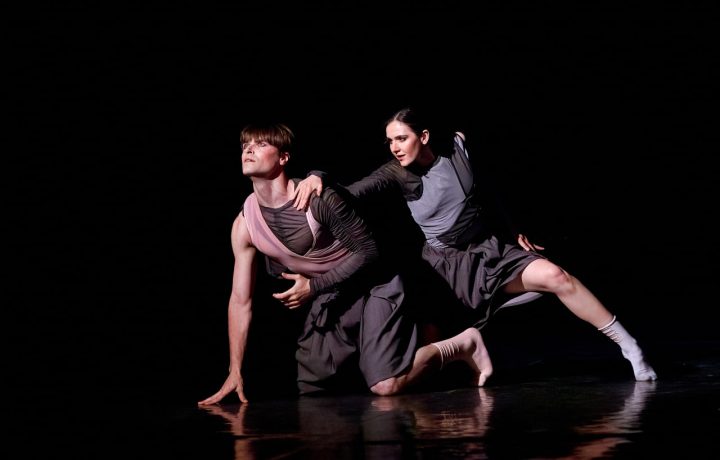
Perhaps never before has the language of plastic movement possessed such varied energetic currents and such personal, utterly realistic characterisations. Khoma’s brazen, ironic, lively and warm-hearted friends – the seminarians – who now doze through lectures, now follow the Teacher’s spiritual instructions with feigned chastity, now recklessly run riot and make passionate love – everything about them is real! Their nature is steeped in sexuality, life and movement. And perhaps for the first time, I at last saw on stage my unfulfilled dream: not the plot-driven actions between lovers conveyed through movement, but what actually happens between them – an evident flowing of energies! Their hands and movements did not at all come apart into two bodies! On the contrary, each duet created an enchanting moving circle through which, as in a living closed electrical grid, lightning-quick currents of passion ran. Love, seduction, betrayal, and a savage, primal ecstasy – swept through the air in a squall… and there love walked hand in hand with death.
Do not ask for whom the bell tolls
And where, in that inferno, had Gogol’s half-transparent associations of «Aesopian language» gone? But beware, nothing had vanished! One of the characters, like a stranger, made a particular impression – thanks to his signature, “slippery” plasticity of movement without sharp angles, and his soft, unhurried steps, which made his progress across the stage resemble the wary slithering of a serpent in the grass… That same Teacher at the seminary? – his brief appearance on stage at once brought with it a persistent sense of danger. That same Sotnik (performed by Artem Shoshyn) during the erotic night with the Pannochka (performed by Olena Saltykova) – and once again that elusive sensation of the familiar «slippery» slithering… Stop! What is happening, and into what darkness are we flying? How are we to make sense of these surprises? If in music there exists a system of leitmotifs that depicts the melodic, sonic image of one and the same character, phenomenon or emotion, then can it be that Radu Poklitaru is clearly pointing to a «plastic leitmotif» by which – mark this! – an entirely new character is suddenly recognised by us as one already familiar?..
And while bewildered thoughts went flying headlong through my imagination, the performance was flying – towards its finale! And here, at last! – here he is, VIY! But who is he? The Teacher of the spiritual seminary? The Sotnik – in his own costume, with a giant mask pulled on? Who is this monster moving towards Khoma, towards the auditorium, towards the Universe – with soft, angleless movements?..
And at that moment the earth, with its topographical plot, once again flew out from under our feet! And it left the viewers with a new meaning of Gogol’s Viy – the pervasive idea of a Character who, like the Alien from a top sci-fi horror film, has the property of sprouting forth – in each and any of us: there where he finds permission to do so.
To the Author – from the Author
Radu Poklitaru: «Gogol was in my first version of the libretto – as a character. But then, after the second or third rehearsal, he somehow left: as if he had said hello, looked round to see that all was well – and gone. As much as to say: «You’ll manage here on your own without me!»
Text: Anna ARKHYPOVA
In detail: Kyiv Daily