What the eyes cannot see
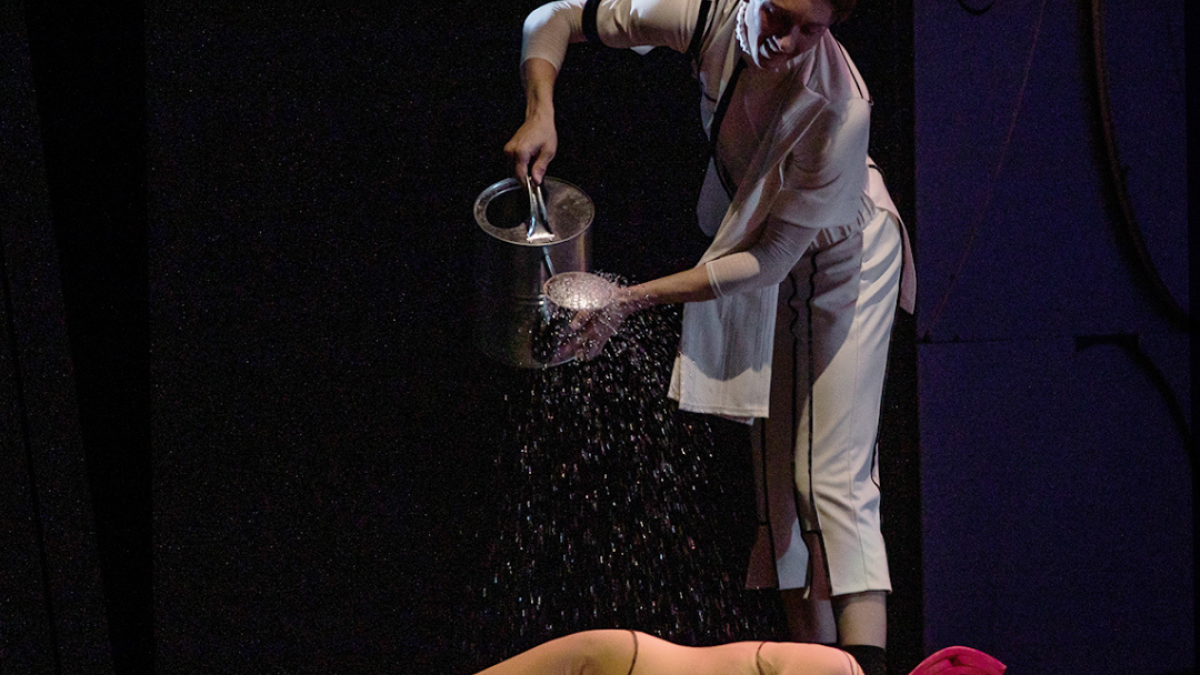
“Multidimensional action is always more interesting than one-dimensional, and I thought that in this cocktail — Exupéry, Mozart — it would be wonderful if Ukrainian folk melodies appeared,” — that is how Radu Poklitaru presented the new Kyiv Modern-Ballet performance “The Little Prince” (starring Artem Shoshyn). The online premiere was watched by over 17,000 viewers; on October 21 the miracle truly happened to us.
The book by the outstanding French writer, poet and thinker, pilot and scientist, designer and inventor, the legendary Antoine de Saint-Exupéry (1900–1944), has been read down to every letter, learned by heart in quotations, and there is hardly anyone left on planet Earth who is not acquainted with the Little Prince. The philosophical dimension of this lyrical fairy tale is conveyed through emotion by the language of ballet. Why? Because we essentially live for the sake of emotions. Without them, it is as if we do not exist. The emotional cocktail created by Radu Poklitaru will affect you for a long time, revealing ever new feelings. The Master has invented a unique recipe!
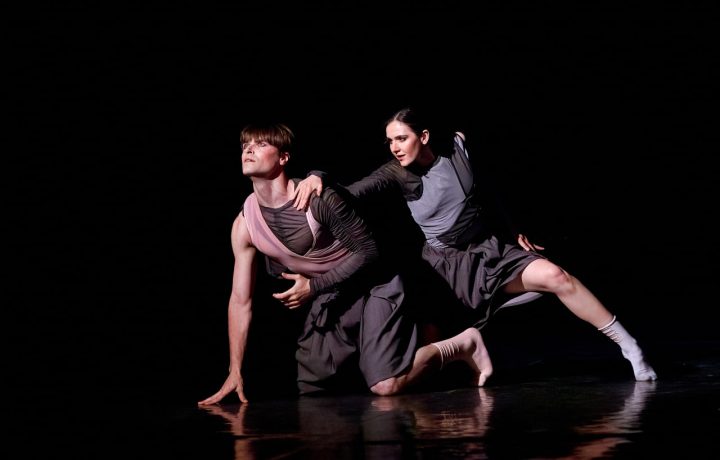
Dmytro Kuriata, the costume designer and a constant creative partner in Radu Poklitaru’s productions, admitted in one interview that the costume concept was influenced by Saint-Exupéry’s graphic drawings. But do not look here for direct visual quotations, although the characters’ attire is indeed the colour of book pages, marked up with an ordinary pencil. The idea recalls children’s colouring books, where the characters’ clothing is drawn only halfway: an invisible vertical line divides it into two parts – the real and the imaginary. The real part has a clearly defined cut, emphasised by black piping lines. The imaginary part is like a blank sheet of paper without graphic accents; its cut and its shifting form during the artists’ movements are improvisational. The rest is filled in by your imagination.
The economy of visual accents becomes symbolism. The Rose is fragile, unprotected, as if bare – with a single adornment: a magnificent royal bud of vivid colour upon her head. A lonely coat rack on the stage (you do remember how true Theatre begins?), bearing the various clothing accessories of the inhabitants of the Planets (into whom, before the eyes of the audience, Dmytro Kondratiuk – who is also the Pilot – transformed) – it is precisely this coat rack that eloquently hints: seek all the characters – within yourself. Those planets are the inner Cosmos of each of us. And the rest is merely accessories.
And only the Serpent, black as an abyss, the Biblical character with the apple of temptation who kills the Little Prince (or perhaps does not kill him?… what if the Prince merely falls asleep, to be awakened by a final kiss from his beloved Rose, just as Sleeping Beauty, who likewise was tempted by an apple, once awoke from the kiss of her beloved?.. who knows, who knows..) And so, only the Serpent (the magical, prophecy-like performance by Michel Fondu), who coils into a taut nest or unfurls to gigantic dimensions like the very banner of Evil – attains incredible plasticity and stage expressiveness of movement thanks to the visual effect of the artists’ black-and-white costumes, who for a few eerie moments of the ballet become particles of his supple and all-powerful body.
But where are the colours and the sun, the adventures and the rainbows? Where are the vivid hues of childhood, – the spectator will ask?
And here the third dimension of the ballet “The Little Prince” appears – the multi-genre, colourful sets and 3D video projections by Olha Nikitina. This is where the surrounding digital world bursts in and modulates the space, irritates or enthrals, transforming – either into an infernal thunderstorm with clouds, against which the little plane bravely battles, or into cartoons and comics, or into cosmic expanses rushing towards you like documentary footage from NASA, or into a wild roller coaster, or into illustrations from Saint-Exupéry’s own book, coloured in like old black-and-white film!… This multimedia riot crashes down upon the spectators with such powerful, vivid reality that sometimes, as in real life, you come to your senses realising that you have ceased to feel in your heart – the child, and the Little Prince, and the magic of art, and your very self. Then, catching yourself in an instant, you tear back through this frenzy once more towards the source, towards the black-and-white letters – the Author.
“In this life it is impossible to do something absolutely new, but one can do it far better than those who came before you” – Radu Poklitaru quotes his favourite saying. Not to lose, but to reveal new meanings in world-famous works – has long become his personal creative challenge, an unconditional artistic need, and, it seems, – a hallmark of his creative style. The Master’s interest in a new reading reminded me of the established tradition of folklorists – when ancient melodies are passed from mouth to mouth, acquiring features of the present day.
The way this came about in the ballet The Little Prince looks most astonishing in this interpretation of Saint-Exupéry, and to my mind – an innovative dimension of Radu Poklitaru’s artistic reality. Seek it not in the visual sequence, the costumes, the 3D sets, or the choreography – unique in its expressiveness and the filigree carving of its images.
No! Let tradition forgive the phrase “ballet accompaniment”, but it belongs – to the Music! And it is precisely here, in the music, that the main events of the ballet will unfold, invisible to the eye.
The symphonic works of the young Mozart, his orchestral and piano works that children study in music schools – bear the imprint of that brilliant season of childhood about which adults speak so much. And yet, how many adults are able to feel and to respect this brilliance – in their own child? Childhood is a special period of life: the memory and wisdom of cosmic experience are still at work (you do remember the Little Prince’s travels among the planets with their eccentrics?), while the real world of Earth so enchants with its novelty and beauty! It seems the phrase “young and green” was born of carelessness and condescending thinking… Because in truth, children are utterly mature and harmonious personalities who merely happen to be living at a biologically young age. Children do not know what “evil” is – at all, until it is demonstrated to them – by adults. Children are able to love and to feel the genuine as strongly as a grown person only begins to strive to in the years that follow. Children, every moment and ceaselessly – grow. In the very way that adults will later consciously try to. Thus, the work of the little Mozart is testimony not only to a genius, one in a thousand. It is testimony to childhood as a brief season of human genius. “It is astonishing how a child – and quite a little boy at that, 8 years old! – wrote music that is still alive, still moving, still touching and astounding us with its perfection!” – Radu Poklitaru says with delight.
Mozart sounds – and the whole world vibrates and resounds in those sounds, polyphonically. But the fullness of those sounds began with a single one – the voice through which we all enter life: the voice of mother, her tender lullabies. A pure voice-melody, amid the clamorous world, like a sound-umbilical-cord, binds you to the Cosmos, brings you to Earth, accompanies you here, and in its own time binds you with it once more. In the plot of the ballet The Little Prince, this is exactly how everything unfolds. The lullabies, in the unforgettable performance of Maria Pylypchak, appear at the key moments of transformation – as the assembly points of the entire production’s structure, on the fine edges of life and death, at the intersections of the parts of the dramatic action of life and of art. And they arrive – these symbols of change – with the precision of a cosmic chronometer.
And here, attention! You did not see it – you heard it! Unlike the book, Radu Poklitaru introduced a new character – the Mother. And she is the boy’s mother, the Mother of the World, the Mother of God and your Homeland, and your native planet Earth – all of it is in her, through the texts of ancient Ukrainian lullabies, through the single Word that is permitted to sound here.
Her image in the production is invisible, for you do remember?… “It is only with the heart that one can see rightly. What is essential is invisible to the eye.” But she will quietly lead you through the production, as through life – from the very beginning to the finale. For the first time the voice of the lullaby will take up the broken Pilot in the desert, on the threshold of death – and will carry him into his own childhood, where he is the Little Prince, about to explore his new, boundless Cosmos. “Hush-a, hush-a, little dove, Fall asleep now, my little love, You shall sleep so soft and light, son, You shall rise up well and bright, son.” After all the magical travels among the Planets, after the meeting with the love of his life – the Rose, the Little Prince at last flies off to master a real planet, his native Earth – he flies in order to be born a human being into his family, and it is at this very moment that the lullaby sounds for the second time: “I’ll hang the cradle on the fir tree’s bough, And off to Ukraine I’ll wander now, A gentle little rain will fall and drum, And it will keep my little child in fun.”
The second act of the ballet, on Earth, begins with the meeting with the Fox (the unforgettable Illia Miroshnichenko), which will turn upside down both the heart and the whole life of the Little Prince. For in essence, Saint-Exupéry’s confession about friendship – is the eternal Biblical question, “love thy neighbour”, and – who is he, your neighbour? And here, pointing to the extraordinary nature of the coming event, to the new birth of the Little Prince and of his humanity, – the lullaby sounds for the third time, playful and teasing: “Lullay, lullay, I rock you so, If you won’t sleep – then off you go. I’ll lay you down beneath the bench, And out into the street I’ll wrench. Out in the street the pipe does play, But mother will not let me stray.”
What began as a jest seizes the hero’s deepest feelings, and in the ballet this is one of the dramatic climaxes – when, against the backdrop of mischievous, unconditional happiness and the merging of two lives into a single stream – the tragic music of Mozart sounds in contrast, and splits the consciousness like a cross – into the depth of the pain of loss and the breadth of happiness without end. Friendship gave the Little Prince what first love did not – new wings, boundless faith in himself and the ability to fly, for at parting the Fox gave him – a paper plane! A symbol that Antoine de Saint-Exupéry would surely have invented had he wished to continue his book… An example of “events occurring only in the music” – will appear once more in this episode, after the farewell to the Fox, when the warm and harmonious Mozart is literally “trampled” by the alien rhythm of the artists’ feet. When different temporal dimensions collide in conflict: the one by which the life of the heart flows, – and the one with which the surrounding world bursts in.
For the concluding, fourth time, the dramatically themed lullaby “Sleep, Jesus, sleep” sounds in the finale of the production – and strikes with the depth of its text, in which the earthly thorny path is extolled. On the stage, synchronously, through pauses of darkness and silence, fleeting little scenes from the life of the Little Prince are “turned over” like pages. Upon the dotted sound-thread of the lullaby, the Little Prince leaves the spectators and the production, kissing his Rose. And we?… And we await his return!
The project was carried out with the financial support of the Ukrainian Cultural Foundation and the Department of Culture (Kyiv City State Administration)
Anna Arkhypova