“The Long Christmas Dinner”, or what does life taste like?
The holidays are a time when everyone tries to forget everyday routine and problems and gather with family around the Christmas table.
Taking family dinners as a way of measuring time, and human experiences as the language of dance, the choreographer and director of “Kyiv Modern Ballet” Radu Poklitaru “treated” audiences to the premiere of the performance “The Long Christmas Dinner”.
The story, originally written by the American writer Thornton Wilder as a libretto for an opera by the German composer Paul Hindemith, has taken on new and fresh colours in the choreographic extravaganza from “Kyiv Modern Ballet”.
The company, which has existed since 2006, has already established its productions as ones that stand out not only for their dance content and the distinctiveness of their themes, but also for the unusual representation of long-familiar works.
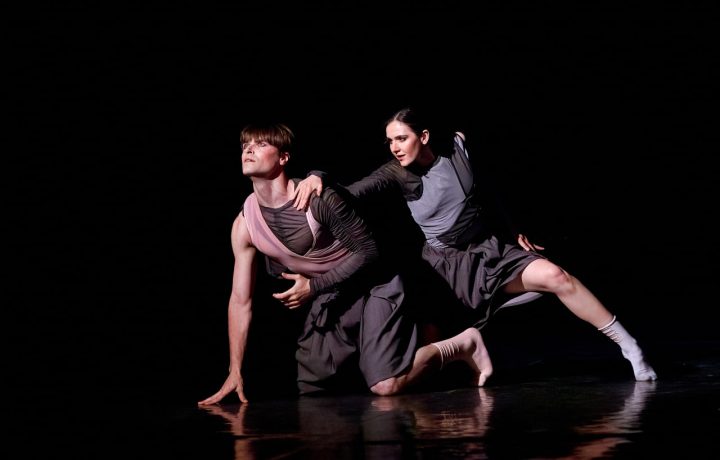
Taking classical music as their foundation, the artists, under Poklitaru’s direction, sketch out new illustrations of the lives of different people.
For the musical content of the ballet, the concert cycle “The Four Seasons” by Antonio Vivaldi was chosen, and not by chance. As the choreographer-director Radu Poklitaru says: “The Four Seasons” is about the fact that everything passes, everything changes. That is precisely what is emphasised in the production.”
Before the showing of the one-act performance “The Long Christmas Dinner”, the spectators, absorbed in their gadgets, plunged into the world of social media. Yet not everyone stares at the screen; many reread the libretto, play with their children, share the news.
Poklitaru, the choreographic compiler of this “recipe for family relationships”, also appears in the hall; he exchanges a word or two with someone and hurries off to the dancers.
And then the lights fade, the spectators switch off their phones and fall silent in anticipation of the dance “treat”. The dinner begins. Incidentally, when translating the title “Long Christmas Dinner”, one might also resort to the word “supper”.
The English “dinner” means the main meal of the day or of the evening. It so happened that in America, particularly in the southern regions, the main course was eaten in the middle of the day, since farmers had to fortify themselves well in order to work the rest of the day. In the evening, however, they ate a lighter “supper”, when they would also “sup” soup.
But the protagonists of the dance feast staged by the artists of “Kyiv Modern Ballet” are aiming at anything but a light dish — one that will be even harder to digest. And it is not just a matter of the choreographic seasonings and exotic ingredients of the dance production, but rather of the theme that the performance raises.
Before us unfold scenes from the family dinners of the Bayard family over the course of 90 years.
From the very first notes, the production takes on its own individual rhythm — unpredictable and changeable, like human emotions.
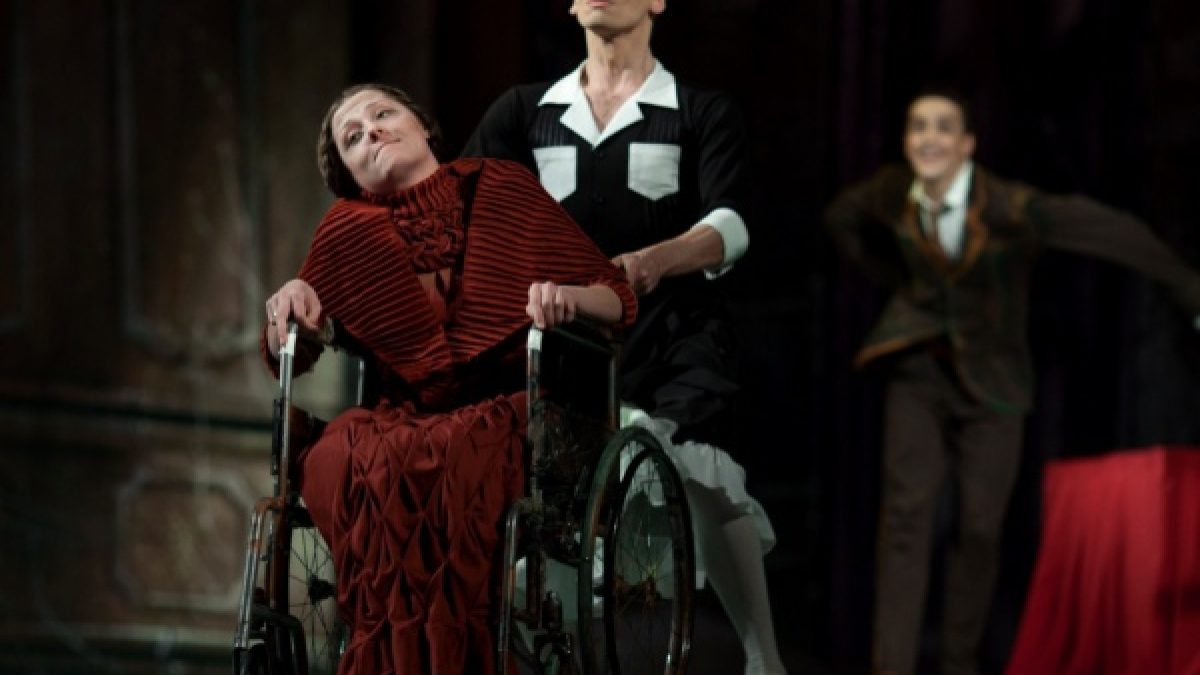
Young protagonists and an old lady in a wheelchair appear on the stage; everyone sits down, converses and enjoys one another’s company. Circling alongside the family circle is an eternal companion — the maid, who will be at hand and will observe the lives of the various generations of the Bayard family.
Of course, she will not live forever, yet each generation will have a helper who will place newborn children into the hands of happy parents and wheel away the chair with the family’s elderly members, seeing them off. In Wilder’s original libretto this figure is unremarkable, but in the ballet it is precisely the maid who frames the performance, uncorking a bottle of champagne as a symbol of the explosion of human emotions and the celebration of life.
And so, note by note, movement by movement, year by year, generation by generation, we watch as a child grows, plays with its parents, studies and becomes an adult. And those parents who so recently ran about with their children are already sitting in the wheelchair. And a new — yet another — Christmas dinner begins.
It is worth saying that the artists try, at one and the same time, to show the similarity of certain traits in different members of the family, while each character also has his or her own individuality.
Each has their own misfortune: someone begins to drink, someone smokes, someone suffers from the loss of a child, someone goes mad in the search for their path and for love, someone goes off to war, heedless of the pleas of their loved ones.
There are mothers who bring children born out of wedlock into the family and who later become part of the Bayard family, and sons who bring their lovers to meet their parents, shocking them with their choice.
The only thing that is the same for everyone is time, which drives us forward along that same circle, from generation to generation, from dinner to dinner.
A child is born, grows up, finds its other half, starts a family and itself grows old, watching over its own children. While in the original libretto the ageing of the characters is suggested to be emphasised by means of wigs, the ballet demonstrates this through the plasticity of the body and the distinctiveness of the movements. While the doors that symbolise Birth and Death in Thornton Wilder’s libretto are one and the same, in the ballet these are separate processes.
The depth of the theme touched upon and a certain tragic quality of the characters’ fates are somewhat softened by a kind of afterword to the production, in which all the characters who have departed this life continue their dinner somewhere up there, in heaven. The dancers appear before the spectator in the costumes of angels, who are even now absorbed in the vicissitudes of earthly life. That is why this “Christmas dinner” is also “long” — because it never ends.
The spectators applauded for a long time and came up to ask for autographs and to give flowers.
Speaking about the new work of “Kyiv Modern Ballet”, Radu says that it is one of the longest-running productions — much like the content of the performance itself. Its creation began back in 2009.
The choreographer wanted to make his own interpretation of the play, one closer to contemporary realities. But Radu Poklitaru did not set out to draw any special links to what is happening in Ukraine:
“I would not draw a direct association between the ballet and what is now happening in the country. What I sought to show in the production is not about the second-by-second change of events in Ukraine, but about what humanity lives by in general. As an author, I am very drawn to the very idea that a person ought to live their life as fully as possible. And one must live one’s life by giving, not by taking. And I hope that all the spectators left with thoughts about why we live.”
Olha Herman
UKRAINSKA PRAVDA