A man’s confession. What hooked us about the Ukrainian show-ballet “The Little Prince”
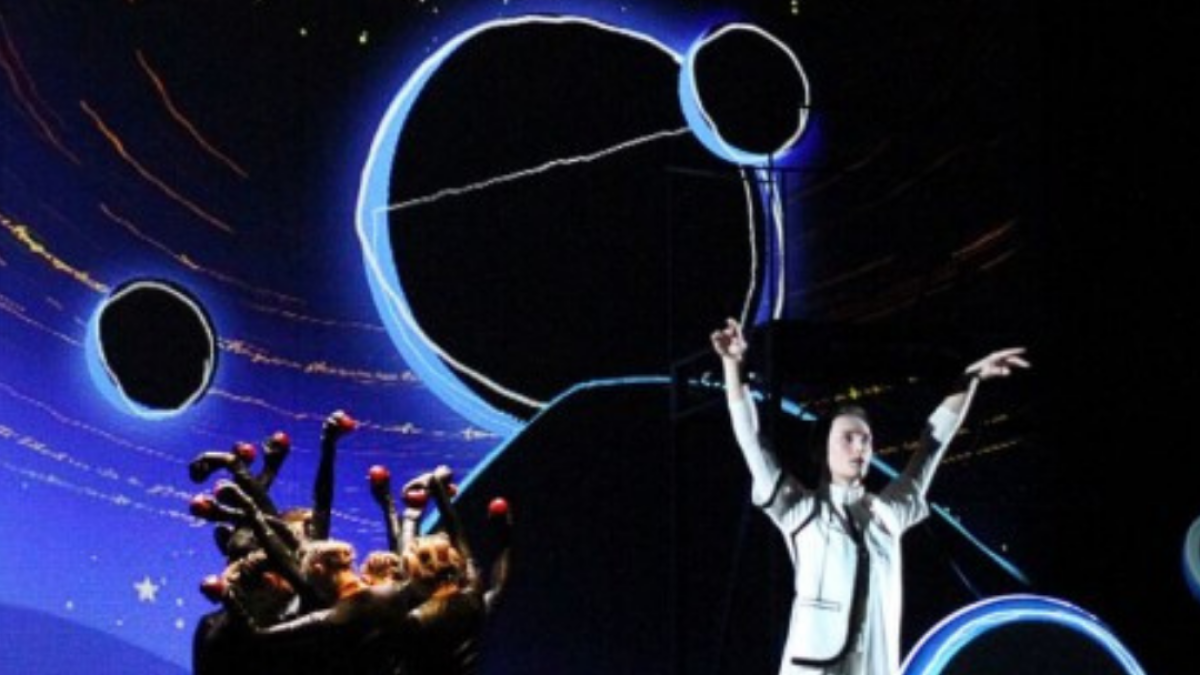
In the production “The Little Prince”, Radu Poklitaru revealed all the secret, deep meanings embedded in this work.
Ukraine has hosted the online premiere of a large-scale show – the ballet «The Little Prince» by Radu Poklitaru. A month earlier, Focus had announced the event in an interview with the choreographer – one of the most original ballet masters in the country.
Around 4,000 people watched the show-ballet online, and over the weekend another 17,000 did so. Access to the broadcast is now closed; in November the ballet will be performed offline at the IICA (the former October Palace).
The production used 3D video-mapping technology, that is, three-dimensional imagery. Hence the substantial budget of the production – UAH 2.6 million, allocated by the Ukrainian Cultural Foundation and the Department of Culture of Kyiv.
For children, in a grown-up way
The performance turned out to be spectacular and deeply moving. Poklitaru lays all of Antoine de Saint-Exupéry’s cards on the table, revealing that «The Little Prince» is no children’s fairy tale at all, but the poetic confession of a mature man. «The Prince» was written in 1942, two years before Saint-Exupéry’s death (1900–1944). An American publisher had commissioned the writer to produce a work for children. He fulfilled the commission, but into this fantastical, allegorical tale he encoded the life experience of a man over 40. Recall that Radu Poklitaru told Focus he had long kept the symphonies of the eight-year-old Mozart tucked away in his creative reserves. Then he dreamed that this music would fit the plot of «The Little Prince» perfectly. Interestingly, this same connection appears in Saint-Exupéry himself, in his book «Wind, Sand and Stars». There he described a boy he had met by chance: «I gazed at that smooth brow, those soft, full lips, and I thought: here is the face of a musician, here is the little Mozart, he is all – promise! He is just like the little prince from the fairy tale».
As for the Rose – she is beautiful, playful, capricious and somewhat cruel. She literally «looms» with her exquisite legs over the timid Prince
Besides Mozart’s music, the choreographer used heart-rending Ukrainian lullabies performed a cappella by Mariia Pylypchak. They play an essential role in the production.
Captives of their own ego
The first scene. An aeroplane carrying the Pilot fights its way through clouds and gusting wind. The flying machine is made up of various geometric shapes, and one of the dancers spins the propeller. When disaster strikes and the aeroplane falls apart (a symbol of the Pilot’s outer shell), the writer’s inner world bursts out. In the desert the Pilot meets his alter ego – the Little Prince. He is a golden-haired boy in a cloak, with a sword. A little knight, just as de Saint-Exupéry, a provincial French nobleman, always felt himself to be.
«The Little Prince» is no children’s fairy tale at all, but the poetic confession of a mature man
In Poklitaru’s version the Little Prince is not so little: he is portrayed by a slender young man in white, with a delicate, boyish face. The Prince told the Pilot that he had come to Earth from space, where he lived on the asteroid B-612. There he lives with the Rose (the prototype of Antoine’s wife – Consuelo Sandoval, who after her husband’s death wrote the touching book «The Tale of the Rose»).
On his asteroid the Prince has three volcanoes (there are plenty of volcanoes in Consuelo’s homeland – El Salvador): two extinct, the third still active. They personify three periods of life: childhood, youth and maturity, which still blazes with fire.
As for the Rose, she is beautiful, playful, capricious and somewhat cruel. On stage she literally tramples our Prince with her exquisite legs and climbs up onto his neck. The Little Prince rises to his feet with her on his back. «But the little prince is a muscleman. Not quite how I imagined him», viewers commented ironically online about the premiere. «And the Rose is a bit plucked-looking», chimed in another «connoisseur».
Behind the Prince and the Rose there is a mountain shaped like an elephant. We remember from the book that this is a drawing of a boa constrictor that has swallowed an elephant. The boa is a serpent, the diabolical principle. The elephant is divine wisdom and kindness of heart. Yet this creature has managed to devour him! By and large, freeing the elephant from the boa is the central task of Saint-Exupéry’s work, but let us not get ahead of ourselves.
There is a wonderful lyrical little scene in which the Prince kisses the Rose’s feet. Soon, however, something «comes over» the Rose – she begins throwing a mirror onto the floor. The Prince has had enough of all this, and he sets off on a cosmic journey across the neighbouring planets on a team of doves. These are the asteroids of the King, the Lamplighter, the Drunkard, the Conceited Man (the Singer in Radu’s version), the Businessman and the Geographer. Here the 3D video-mapping technology had plenty of room to play. The ruler appeared against the backdrop of a red-and-black crown; the Businessman had a planet shaped like a cube covered in figures; the Drunkard’s world was a bottle and walls filling up with red wine.
Each of these masters has arranged his planet according to his own ego. And each one’s egoism strives to subjugate the Prince. The King sat down on him, trying to turn the Prince into a throne (just as any politician does with his voters). On the Businessman’s planet everyone walks in a straight line; the Conceited Singer turned the Prince into a microphone stand; and the Drunkard tried to make the protagonist his drinking companion. Only the Geographer demanded nothing in particular, but pointed out a planet of unprecedented beauty – Earth, to which our friend duly sets off.
Here, against the backdrop of space, an astonishing lullaby is sung by Mariia Pylypchak: «I will hang the cradle on a fir tree and set off for Ukraine myself. A fine rain will fall, it will amuse my child. I wandered all night and am wandering still. And my child is crying – for I can hear...». Some mother she is: the abandoned child is «amused» by wind and rain. The lullaby introduces into the performance the motif of the abandoned child: indeed, the Little Prince is always without parental care. He is left to his own devices: only cosmic winds rock his cradle.
The appearance of the devil
Earth turned out to be a dangerous place: at the hunters’ gunshots the Doves instantly scattered – and the Prince was left without a means of transport. And the first creature he meets here is the Serpent, the embodiment of the biblical devil according to Radu Poklitaru.
The Serpent has a retinue made up of a multitude of serpent-women. Each one holds an apple of sin, like Eve. This scene is one of the most striking pieces of choreography in the production: the serpent-women first weave themselves into a black net, then form the Serpent’s enormous body – its head, in a black tricorn hat, rising menacingly over the small figure of the Prince. But on Earth the Prince also makes a true friend – the Fox. They make every movement in unison: they ride a roller coaster and launch paper aeroplanes. There is no egoism in their relationship; it is full of childlike spontaneity.
Here the Prince comes upon a garden of roses – all of them lovely and resembling his own Rose, of whom he immediately thinks. But he realises that he loves only her, the one and only.
It is a very beautiful scene: the Prince above, in the cosmic darkness, with an umbrella. The alluring Rose below. He tosses her the umbrella – she catches it gracefully: a touching metaphor for a man’s care for the woman he loves.
If at the start of the ballet we saw the down-to-earth, horizontal aspect of their lyrical relationship, then once the Rose and the Prince find themselves far from each other, the spectator beholds a poetic image of their love. Distance always brings out something essential in our feelings. The Rose is enchanting with her openwork umbrella, but here she exists only in the Prince’s memories.
Friendship and love
And once again the Serpent-devil appears on stage, offering the Prince his services: death from an apple poisoned with sin. When he dies, his soul will be reunited with the Rose in the other world. For the devil, in various works, death is the best way out for a human being.
The Prince cannot make up his mind for a long time, but then the Serpent conjures up an astonishingly mesmerising image of the Rose, glowing seductively in the blackness of space. And so, from the tempter’s hands the apple passes into the Prince’s palms; he bites into it and falls down dead. The Pilot catches his body and cries out soundlessly in grief. At this tragic moment we hear the lullaby: «Sleep, Jesus, sleep». It is sung in the voice of the Virgin Mary addressing the infant Jesus: «Sleep, my Long-Suffering One, sleep, close your little eyes! Do not ask what will one day come, that people will make ready a cross for You... Lullaby, my little heart, lullaby». The whole auditorium was weeping.
Poklitaru drew two parallels: between the Serpent in Saint-Exupéry and the biblical devil, and between the Prince and Christ. The Prince dies for us all, saving the most precious and most important thing from decay. And what is that?
In the finale, in the Prince’s posthumous consciousness, we see everything he encountered in life, the planets he visited. They vanish – and what remains?
Two things: a joyful embrace with his friend the Fox and a kiss with the Rose. The final scene: the Prince and the Rose freeze in a kiss, their arms flung back as if in flight. For the devil, Friendship and Love prove invulnerable. This is the central idea that Radu Poklitaru saw in Saint-Exupéry’s work. And he has magnificently embodied it in his new show-performance.
Konstantin Rylev