Survive. Betray. Go blind
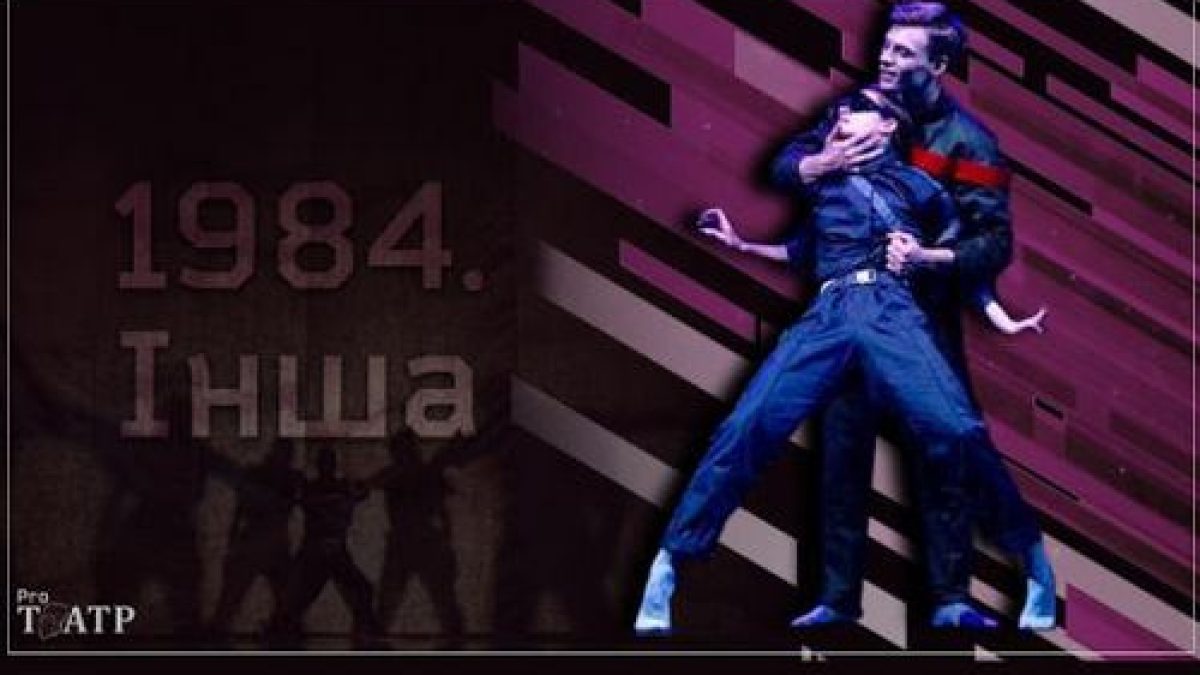
Illia Miroshnichenko and Kateryna Kuznetsova presented a premiere at the Kyiv Modern-Ballet Theatre — the dystopian ballet “1984. Another” based on George Orwell’s novel.
“We don’t need the clever ones. We need the loyal ones.”
“Hard to Be a God”, the Strugatsky brothers
Illia Miroshnichenko and Kateryna Kuznetsova presented a premiere at “Kyiv Modern Ballet” — the dystopian ballet “1984. Another” based on George Orwell’s novel. They also performed the lead roles of the production — She and He. It is not by chance that their characters have no specific names, unlike the prototypes. For the cult novel, embodied in the language of the body, sounds not only in George Orwell’s words but also visualises, collectively, the main messages of all dystopian plots in which society has no vaccine against the distortion of its own souls. And, most importantly, it once again poses the question of whether love alone is capable of breaking the bonds of a reality warped by lies.
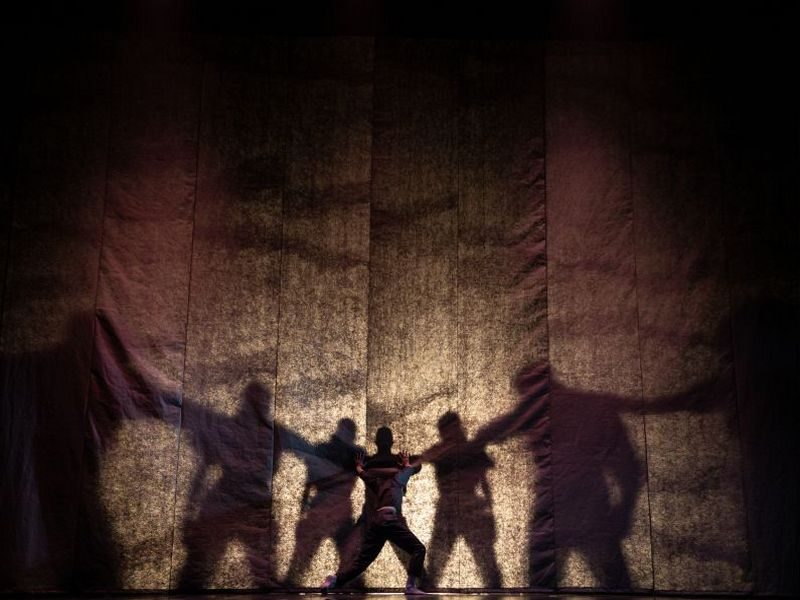
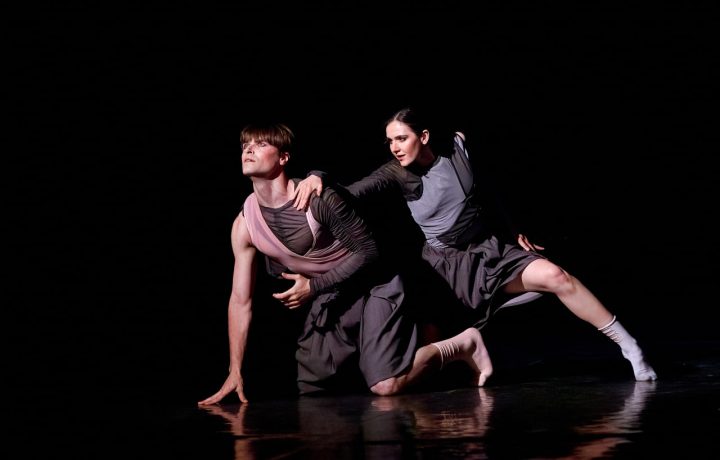
The hybrid world of propaganda, whose terrible seeds seemed only a warning to future generations back in the last century, today has acquired its body, concrete outlines and even names. In their interpretation of the famous plot, the choreographers deliberately depart from the work’s usual context. The novel turns its ideas into a choreographic drawing in which He, like everyone else, is a khaki-coloured person, only with a red ribbon-mark on his heart. Like everyone else, He takes the pills of propaganda regularly, obediently, thereby dulling any other senses. “Big Brother” controls everyone’s breathing, putting the madness of slogans into their consciousness, driving their state to a reflexive, animal growl from behind the bars of a cage.
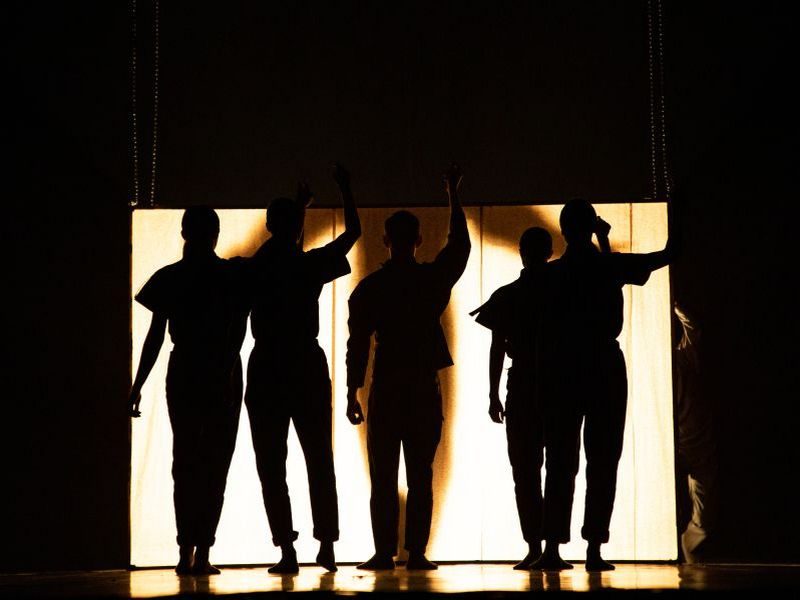
In a single impulse the dancers raise their devotedly crossed arms upward and masterfully, in the style of “body percussion”, reproduce the single breath of an unconscious social machine deprived of its own “Self”. The “Kyiv Modern Ballet” company has long been famous for the exceptional style of its choreographic school, which reveals itself in each dancer’s individuality. Here the ballet organism of 9 artists (Vladyslav Dobshynsky, Kateryna Kurman, Roman Kushnerevych, Oleksandra Maksymchuk, Valeriia Melnychuk, Violetta Petrolai, Dmytro Pohribnichenko) is expansive and unified in its expressive vocabulary, which — together with the contemporary music of Hildur Guðnadóttir and Hauschka, without any expensive special effects — makes one plunge into a chilling world where the individual is broken as easily as a match.
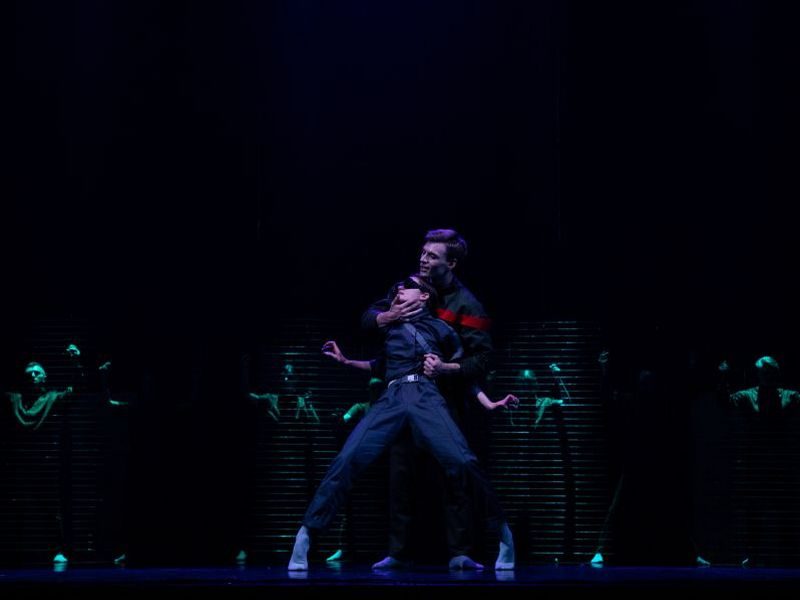
She is blind, or consciously chooses pure darkness instead of the black world of lies. She covers her eyes with black glasses and, like Grigory Gorin’s Swift, will feel this world only by touch — until love removes this gloom from her eyes. But the system destroys even this feeling, breaks it from within so that even the enamoured He betrays Her, just as Winston betrayed Julia in the eponymous novel, because, as Orwell said, better her than him. And that too is a choice. The artistic work with light gives the production volume and a certain dynamic pulse, when the play of reflections, rays and shadows complements the choreographic dynamics.
“We will meet where there is no darkness,” the writer says in his novel, but, in the creators’ view, light too can give birth to darkness, bewitch and blind. The bright spotlight at the back of the stage is an autonomous character of the performance; it is precisely in its light that the illusions and hypnotic shadows of Big Brother are born — it, like true evil, always hides behind the mask of good, thereby deforming the understanding of truth. This very spotlight in the production becomes the embodiment of the absolute antihero, who by the laws of any dystopia cannot be destroyed, and so He, after his defeat in the duel with the searing light, will understand the betrayed Her and now himself will choose gloom instead of light.
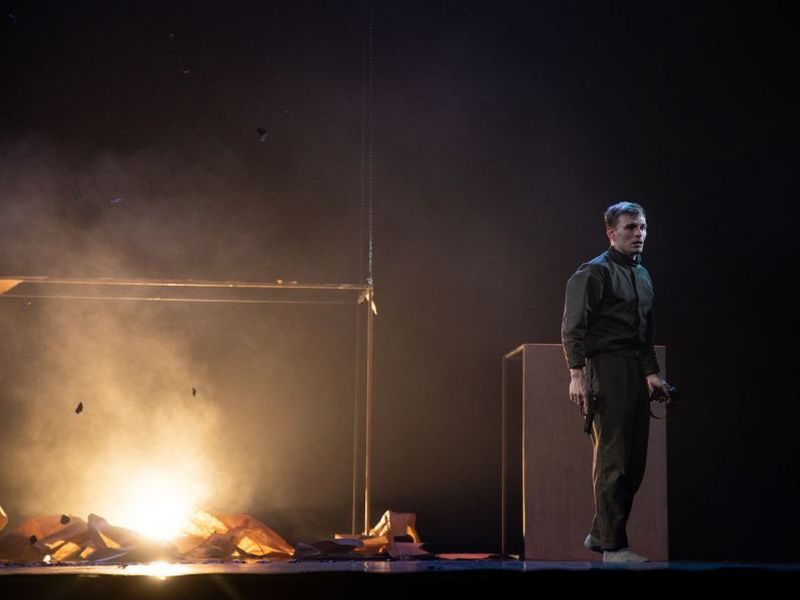
“1984. Another” is indeed a different story from Orwell’s, for it is even more universal for our post-totalitarian society, for a world that lives in the era of post-truth and hybrid consciousness.
Review: Dasha Kashperska
Details: Pro Teatr
Photo: Nastia Telikova