An impressive “parade of planets”
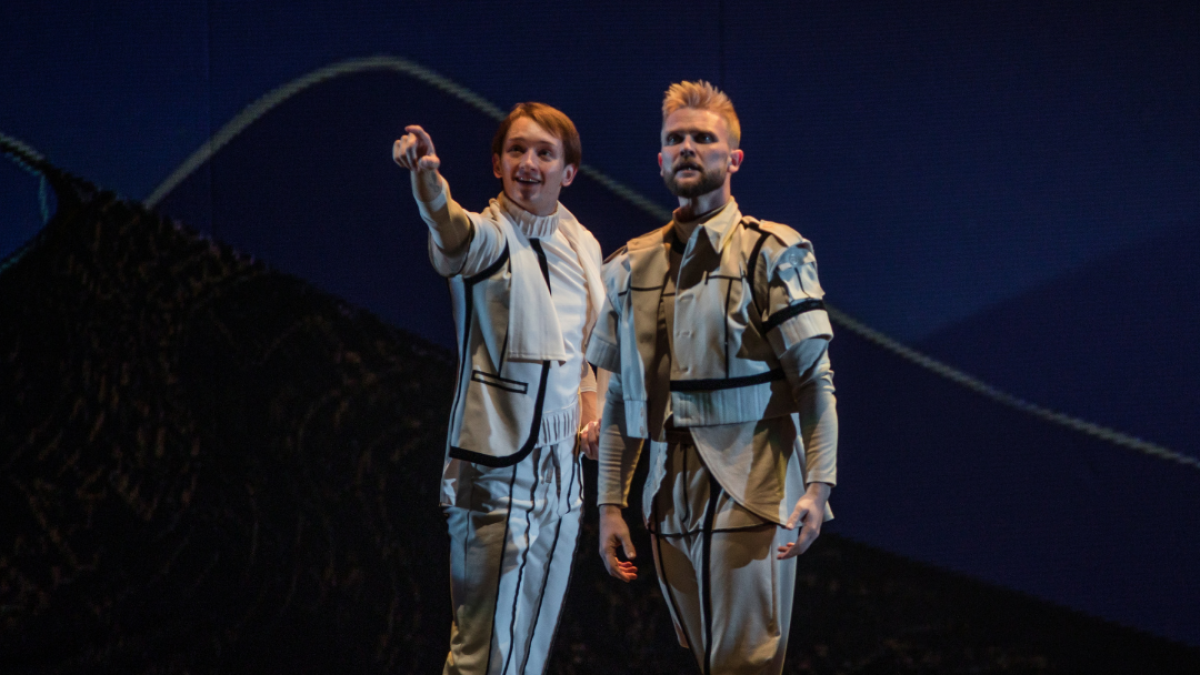
“The Little Prince” is a new work by “Kyiv Modern Ballet” with choreography by Radu Poklitaru.
The production of «The Little Prince» was staged with the support of the Ukrainian Cultural Foundation. The first audiences have already been able to see it online, and soon – a full-fledged stage embodiment will follow...
In one of the provincial French towns I saw an ingeniously decorated entrance to a children’s library. On the spines of the books adorning it were inscribed the names of Balzac and Saint-Exupéry. Such a pairing might seem a little exaggerated to someone unaware of the incredible print runs of «The Little Prince». Antoine de Saint-Exupéry brought fame to France, because his book became a worldwide bestseller. It has been translated into every known language, including the language of choreography — to my mind, the most comprehensible of all languages.
Of the numerous interpretations made from Saint-Exupéry’s work before Poklitaru, I can cite at least two examples of diverse stage embodiments of the ballet. At Munich’s Gärtnerplatz Theatre, Hans Henning Paar set it to the refined but somewhat contemplative music of Erik Satie, Saint-Exupéry’s compatriot. It was strange to see a children’s ballet in the style of contemporary dance and contact improvisation (this is how, for instance, the duets of the Aviator and the Little Prince were resolved). But there is no way to plunge into Space like that. So there is a problem with romantic flights in the production, and with the desired balletic classicism as well. Most memorable of all was the supple little Snake, the one responsible for the protagonist’s demise.
In 2016, the French choreographer Johan Nus staged «The Little Prince» on the Kharkiv stage. Here there was even an abundance of classicism, but too little of the music that suits the work’s style – and the choreography was inappropriate as well. The Drunkard deftly performed balletic tricks that even a sober virtuoso could not manage. In its outward forms and plasticity the Snake bore a parodic resemblance to a crocodile, and the Little Prince was danced by a classical ballerina in disguise. So the genuine theatricality of the spectacle was hobbled, and the idea of the work was barely intelligible.
The concept of Radu Poklitaru and his artistic product, as always, win one over with their harmony and perfection. In this story, sad in a far from childlike way, philosophy is merely disguised as a fairy tale. And everything in it is defined by the music.
In the first part of the ballet, the «symphony of childhood» – these are works by the young Mozart, whom Poklitaru links with the fate of the Little Prince. As Saint-Exupéry wrote, «the difference between children and adults is that adults seek happiness in everything. But children find it in everything»... (besides Mozart’s music, the production features Ukrainian lullabies performed by Maria Pylypchak). In the second part of the ballet, as the protagonist grows up, the themes of a more mature composer are heard, as if steeped in genuine anxiety for the protagonist’s fate.
Poklitaru once confessed that for him childhood – is altogether a beautiful and pure land, from which children are squeezed out by adults. And that is probably why the Fate in Radu Poklitaru’s work becomes not the treacherous little snake, but precisely that biblical Serpent (performed with enchanting inevitability by Michel Fondu), who tempts a human being to turn away from the innocent bliss of existence toward sinfulness and suffering. But perhaps the most difficult task falls to the artist Dmytro Kondratiuk, who plays not only the Aviator, but also the inhabitants of all the planets the Little Prince comes upon. In this kaleidoscope of fleeting guises he chooses the most characteristic features, in order to embody a snapshot portrait of each of his remarkable characters (the King, the Businessman, the Drunkard, and many others).
Poklitaru’s philosophy is far from intrusive moralizing and traditional sentimentality. Indeed, the Little Prince’s asteroid – is the very place where one can set a kettle on a volcano, tidy up its small territory with a broom resembling a guitar, and water the wondrous Rose, with which one truly cannot help falling in love (Olena Saltykova). Indeed, everything is just as in Saint-Exupéry’s work: you wake up, put yourself in order, and then put your whole planet in order too.
The Little Prince, as embodied by Artem Shoshyn, despite his far-from-childlike build, manages to convey the evolution from a naïve «star boy», who wants to find out why the stars shine, – into a victim of dramatic collisions and inexorable challenges of fate. Very organic in this regard is the scene between the Little Prince and the new friend with whom he wishes to make companions – the Fox (Illia Miroshnichenko).
Olga Nikitina’s spectacular video content is so visually captivating that it can compete with Radu Poklitaru’s choreographic design itself, and in some episodes it even pulls ahead in a creative contest with the costume designer Dmytro Kuriata. The choreographer energizes every episode of the action through the unified movement of a group of participants, recreating either the crash of an aircraft (a sad allegory of the recent events near Chuhuiv) or the curving of the Serpent’s head at the front of a massive, mobile mass that as a whole personifies the Serpent’s body. We have already seen something similar in Poklitaru’s previous works, for example, in the striking flights of «Viy». But this is precisely the polished and readily recognizable «signature» style of Poklitaru, which instantly sets him apart from run-of-the-mill ballet masters. Without superfluous pathos, he shows a handmade embodiment of dreams of flight – dozens of paper doves, which we likewise associate with the era of childhood.
In one of his candid interviews, Radu Poklitaru said that he does not know how to create productions for children. That is quite plausible. Although there is yet another rule established in practice. For children one must write the same as for adults, only better... This probably applies as well to the creation of ballets, as the director of «Kyiv Modern Ballet» has proven with his new work.
Oleksandr CHEPALOV, Honored Art Worker of Ukraine
Newspaper "Den": No. 203, (2020)