The premiere of "La Traviata", the development of modern Ukrainian ballet in the conditions of war and the challenges of today: an exclusive interview with Radu Poklitaru
About the hardest part of working on a performance during the war, about the staffing crisis and expectations from the premiere.
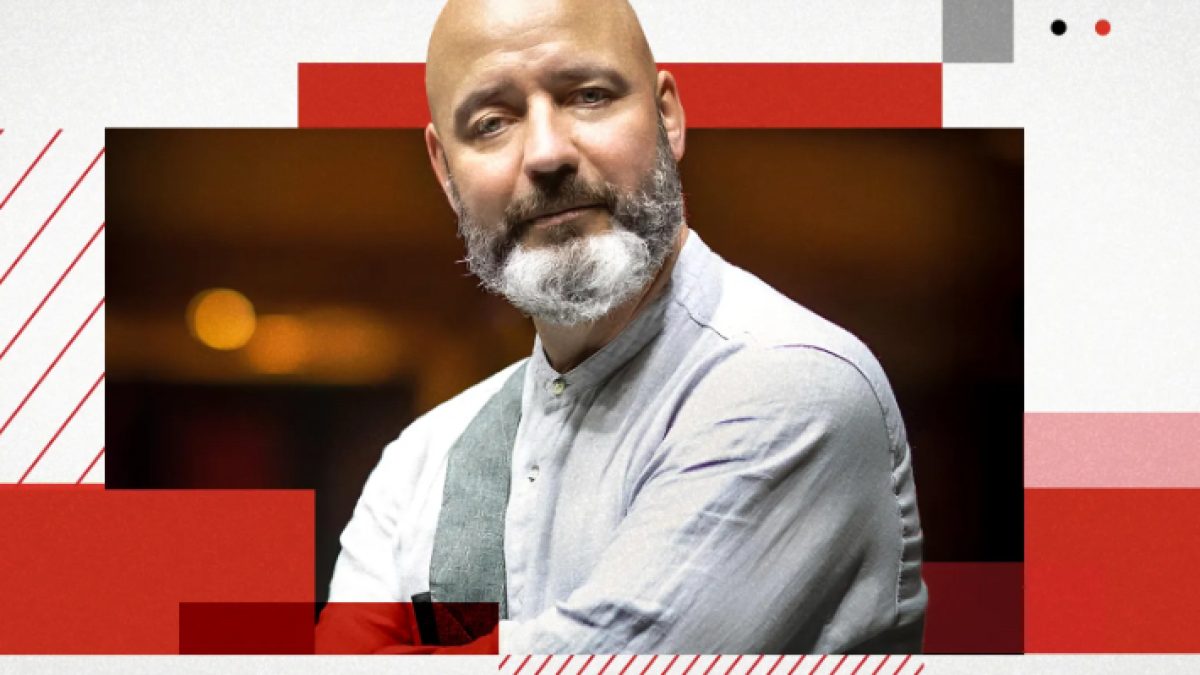
Radu Poklitaru is one of the most renowned figures of contemporary Ukrainian ballet. As a choreographer and the founder of “Kyiv Modern Ballet,” he has transformed the very notion of stage dance and introduced new forms into ballet. His approach blends the traditional and the contemporary, making it possible to create unique performances in which every movement matters.
Since the founding of “Kyiv Modern Ballet,” Radu has had a significant impact on the development of ballet in Ukraine and beyond. He turns classical works into contemporary productions and continues to push the boundaries of the art of ballet. In a country at war, doing this is extraordinarily difficult.
In an exclusive interview for UA.NEWS, Radu Poklitaru spoke about the upcoming premiere of the performance “La Traviata,” working under the conditions of a full-scale war, and the search for ways to create new productions despite the difficult circumstances.
The hardest part of working on a performance, according to Radu Poklitaru
I work out the libretto alone, with a computer. It’s work you could simply call pure bliss. You don’t depend on anyone, you have the music, and there’s just you and the computer. You devise the performance, one scene at a time. This is the most pleasant and trouble-free part of the work. No human factor at all, apart from yourself.
As for the work in the studio, over the years it becomes harder to choreograph, because so much has already been done. And when you start to come up with something, there arises an enormous subconscious temptation to make something out of what has already been created, to repeat yourself. This struggle against self-repetition is a serious creative challenge. And it is probably the most important struggle for me — the struggle with myself and my own clichés.
A personnel crisis: dancers are going abroad
As for the company, of course, right now there is a major problem with young people leaving for abroad. This problem is acute when it comes to dance theatre. Few people think about it, but unlike in drama theatre, dancers have no language barrier. As creative individuals, they are entirely transferable. They speak the language of dance without an accent in any country in the world. That is, they arrive and they dance. They don’t need to go out on stage and struggle with learning a foreign language.
And yet I fully understand all the young people who leave. I realize that I need to somehow counter this and find ways to solve this problem. That is why we hold castings, competitions, and recruit young men. This is an enormous effort to bring up new artists. After all, what arrives is not at once a finished artist of our theatre — a theatre with a great history, with its own specific dance aesthetic, which one needs to absorb. That is not attainable right away; it takes time.
Adapting Verdi’s classical opera to the ballet format
This is a heavily abridged musical version. The actual operatic score runs over two and a half hours. The ballet “La Traviata” lasts a little more than an hour — an hour and fifteen minutes. So, of course, it is a great deal of work — creating a new version of a well-known musical work. This is what I sit down and do during that very first period of creative work I mentioned earlier — alone with the computer. I trained as a ballet master at the Belarusian Conservatory. So I have no trouble reading a score or a piano reduction, and all of this is a great help to me in my work.
As for the libretto, it has actually undergone only minor changes. The most important idea conceived by the authors of the opera “La Traviata” has been preserved.
The idea of the performance — self-sacrifice in the name of love makes that love immortal. This idea has not been changed. And the rest is just some small innovations of my own to the plot. Few people think about it, but some moments that are easy to show and explain in opera or drama theatre, using words, are practically impossible to convey in ballet through the language of dance alone.
For example, family ties. It is very difficult to explain to the audience that a man and a woman on stage are brother and sister. To do this you would have to show the parents, the childhood, so that they grow up together — a whole story that in drama theatre is replaced by a simple greeting: “Hello, little sister!”
All of this applies one hundred percent to father–son and mother–daughter pairs as well. They are simply two men or two women.
For the same reason of the “wordlessness” inherent in the very essence of the art of dance, it is very difficult to convey memories or thoughts about the future. Ballet is about “now,” about “right now,” at this very moment. If I want to talk about the past or the future, I need to make absolutely unprecedented directorial efforts in order to be understood.
And most of the plot changes in our “La Traviata” are connected precisely with overcoming these difficulties, and not with my wanting to be original at all costs or to necessarily change the course of the action of the original source. No, that is not the goal at all. The goal is to make a touching, genuine, profound and honest performance. That is the hardest thing.
What Radu Poklitaru says about working with Olha Nikitina and Dmytro Kuriata
First of all, it is, of course, the incredible human comfort I feel when communicating with these people. And the fact that they are top-class professionals. Most often I don’t interfere in their work at all. Of course, we discuss all the details.
Olha and I are to meet, go through the libretto once more, and discuss when something switches on, when something switches off, when something appears. I’ve seen some fragments. And you might even have seen them in the teaser — those are real fragments of the video projection. I know that whatever they propose to me will be an excellent solution from the very start.
If something doesn’t align with my idea, I’ll make adjustments. But their intrinsic worth as creative individuals is so high that in most cases it requires no adjustment from me. That’s wonderful.
One of my friends, an artist with whom I have also worked a great deal and continue to work, once said a phrase that reassures me in many situations. When I was anxious over yet another project, he said: “Radushko, why are you worrying? We can’t do worse than our best anyway.”
This is about Olha and Dmytro. They can’t do worse than their best anyway. And the same applies to me. I know that, despite all the difficulties, there is still a bar below which I won’t manage to sink.
Working on a performance under the conditions of war
Personally, I have a fairly stable psyche. It [the shelling] doesn’t bother me much; it doesn’t even disturb my sleep all that much.
But I did have to take my dog to Chișinău and leave her there, because she couldn’t sleep at night at all. She had hysterics, she trembled. And some acquaintances of mine had a French bulldog that went grey from the shelling. Because you can’t explain to a dog that it’s shelling, that everything will be fine, that everything will be all right. She is simply afraid of explosions, and that’s it.
As for the artists, of course, it’s hard for all of them. And even though our work begins at five in the evening, after a sleepless night they come in a little sluggish and worn out, physically and emotionally.
Well, what can you do? We work. Are there any alternatives? Just like everyone else. Everyone goes and works, because they have to. Yes, of course, you wish there were no shelling. But we can’t do anything about that.
The performance’s main achievement and expectations for the premiere: Radu Poklitaru’s view
I can’t say what its main achievement is, because I haven’t yet seen the performance. I’ll watch it — and then I’ll know what worked and what didn’t. For now there is no performance; it is being created. Roughly speaking, this cocktail is being mixed, and for the moment I can’t imagine the final picture. I’ve never been able to imagine the final result. That is impossible according to Hegel’s dialectic. In my time my philosophy teachers taught me: the complete incompatibility of the ideal and the real.
Of course, while I’m still at the computer devising it, there is an ideal performance in my head. I can see it quite clearly and in detail, but never in all my years on the creative path has the real performance coincided with what I had imagined. It is simply impossible. It always turns out to be something entirely different.
But I can’t work if I don’t have in my head the ideal performance, conceived alone with myself and the music. It must exist, because I need to have something to push off from. We’ll see what happens. I hope it turns out well. And then you’ll come — and we’ll watch it together.
Attitudes toward Ukrainian artists around the world
Of course, everyone is interested in one and the same thing — how do you work, how do you manage to create under such conditions. Many of my friends abroad now call less often. At the very beginning of the war they called very frequently and asked how we were doing, what was happening. These are Europeans, and not only.
But on the whole, right now there is a certain carte blanche for Ukrainian art. It continues, and that is gratifying, because thanks to the fact that we represent Ukraine, more doors open to us than before. That’s good.
People still often look with surprise at art of such quality coming from a country that is at war. It seems impossible to them. And we now understand and prove, first and foremost to ourselves, that it is possible.
“Kyiv Modern Ballet” celebrates 20 years: what Radu Poklitaru thinks about the theatre’s changes over two decades
I would say that the professional level has grown considerably. We all idealize the first generation, and the audiences of the first generation, who saw it, also idealize those who were in the original company.
But now, when I watch the old recordings, I realize that the level of dance — and that is the main thing we’re talking about, to put it simply, our language — has grown incredibly over these years. And that is probably the main difference.
On the whole, of course, the theatre was completely different. We started as a patron-funded theatre. We were founded with the support of Volodymyr Filippov, a Ukrainian patron of the arts, businessman and a great friend of mine.
We were a theatre entirely dependent on patronage, and by feel it might exist, or it might not. It was not a state institution. Back then it seemed that in a year, perhaps, we would cease to exist altogether. But it turned out that, despite the change in sources of funding, the theatre kept living, creating performances, improving its quality and repertoire.
Now, looking back on this path after 20 years, I realize that every step was important. What we have now and what there was before are two different theatres, for certain. In scale and in quality alike. But without that first stage there would be none of what we have today.