“The Little Prince”. A translation from the language of philosophy into the language of dance
The “Kyiv Modern Ballet” Academic Theatre presented an online ballet based on Exupéry’s eponymous novella.
It was a unique premiere. The wondrous world of Antoine de Saint-Exupéry, deciphered in the language of dance and set to the music of an eight-year-old Mozart and authentic Ukrainian lullabies, cast its premiere rays before… the empty auditorium of the October Palace. The coronavirus dictates its rules even to ballet – the audience watched it online – there was a live broadcast.
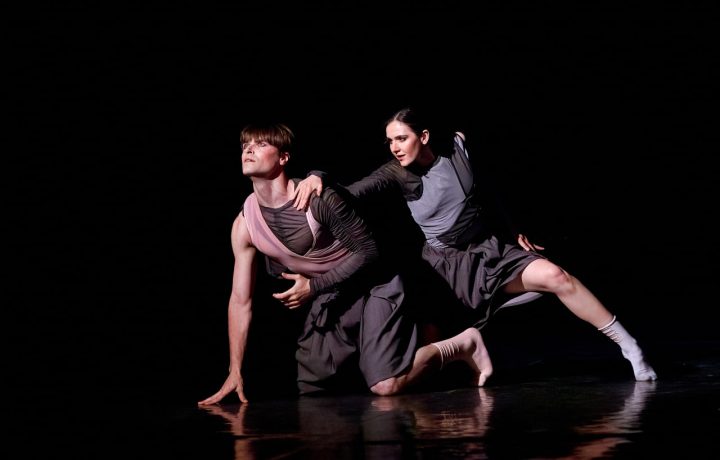
As for me, I was lucky enough to see the premiere of the beautiful and philosophical «The Little Prince» staged by Radu Poklitaru live. The leading parts were performed by: Artem Shoshyn (the Little Prince), Dmytro Kondratiuk (the Pilot), Olena Saltykova (the Rose), Illia Miroshnichenko (the Fox), Michel Fondu (the Snake).
Before the performance began, Poklitaru addressed us (a small group of spectators seated at the maximum distance from one another) with a request unusual for such an occasion: «Please, no applause, even if you really want to», and he joked: «You may cry, but quietly». And I confess, from the very first minute I wanted to shed a tear of childlike tenderness and delight – so realistically and magically did the sky come flying toward me from the stage, and I wanted to dive into those clouds together with the drawn-yet-real airplane. And once the words «Draw me a sheep» rang out from the stage and that sheep came to life – there is no point even speaking of the emotions.
Radu always does interesting and, at first glance, impossible things, and so it was this time too: «The Little Prince» is both a simple and a very complex story.
Of course, the first question is: – How? How can one dare to convey through dance that which is difficult to describe even in words? After all, «The Little Prince» is an utterly philosophical work, and, as in any philosophical treatise, the most important thing in it is the words.
- That is why the most difficult thing for me was to find the most precise choreographic «interlinear translation» in order to render the language of philosophy for children into the language of choreography. After all, to make a direct translation of, for example, the phrase: «We are responsible for those we have tamed» – is practically impossible! Thank God, apart from philosophical maxims, there are a great many emotional things in it that make you both cry and smile. And everything emotional translates very well into the language of dance, because choreography is emotional in itself, – Radu Poklitaru explained to me.
Audiences have already grown accustomed to the elaborate and astonishing costumes with which «Kyiv Modern Ballet» spoils us (just think of the bizarre mask-costumes of the octopuses and other curious creatures in the retinue of «The Sleeping Beauty»! The poor performers complained that at first it was even difficult for them to move). In «The Little Prince» there are also costume changes and cumbersome headdresses, but this has an entirely different character – the characters must be changed in a very short time – it happens right on stage and the audience witnesses the transformation of the heroes. Here, at first glance, everything is different, everything seems simple, but… Why, these are the very lines of Saint-Exupéry himself, in whose graphic art the costume designer Dmytro Kuriata found his inspiration!
- For me the question was, how can one convey in dance the philosophy of this work? How to emphasize it through the costumes? And when I immersed myself more deeply, I understood that the costumes had to be abstract, not bound to time and space. Perhaps somewhat strange costumes – we have certainly never made anything like them before! – Dmytro shares.
The drawings created by Saint-Exupéry have already become classics, a part of popular culture, and the image of the Little Prince has stayed in all our memories precisely as it came from his pen, so the costume designer could not pass this by.
- Considering that the drawings can be classed as naïve art (as if a child had drawn them, and not a professional artist), we used this message in the costumes as well – they are likewise somewhat naïve, stylized and simplified, – Kuriata explained to me.
The concept of «childlikeness» is maintained in the musical accompaniment as well: firstly, in the ballet there sound live (giving you goosebumps) authentic Ukrainian lullabies performed by Maria Pylypchak, and secondly – the music of Mozart used here was written by the genius composer at the age of eight! As it turned out, it was precisely the music of that little boy, and not Saint-Exupéry’s fairy tale itself, that became the starting point for Poklitaru to create the ballet.
- Having fallen in love with this music, for a long time I carefully nurtured close to my heart the idea of a ballet dedicated to it. The form of the concept kept changing. At first it was something entirely plotless. Then Ukrainian lullabies joined Mozart’s music – and the performance became for me a nostalgic and luminous meditation on childhood. And finally all the components of the complex polyphonic mosaic came together – Saint-Exupéry’s Little Prince! – the ballet master recounted.
At the beginning of this report I mentioned the sky that was literally flowing into the hall and into which one wanted to dive, and indeed – throughout the action there was on stage a host of utterly real sets that then dissolved into the air in a magical way. Such visual means are now very popular in Europe and are called 3D-projection technology. The author of this sorcery for «The Little Prince» is Olga Nikitina, so I asked her about everything I had seen in more detail:
- How can this «magical» phenomenon be explained in simple words?
- (Laughs). This is our attempt to make space three-dimensional – we try to achieve the maximum volumetric effect by means of several layers onto which the picture-environment in which the hero exists is projected. We use not just a flat backdrop or a flat projection (the kind everyone is used to), but with the help of 3D technologies we expand the space of the stage to the maximum and fill it.
- So does 3D projection completely replace the usual sets?
- In the performance «The Little Prince» it is combined: the theatrical backdrop is replaced entirely, we use video projection to create a fantastical moving world. But there is also projection onto large volumetric sets that really exist on stage. 3D projection will «bring them to life» and change their appearance throughout the performance.
This is very painstaking work that remains a secret to everyone (including the director and the actors) almost until the premiere! The costumes are sewn in advance, the choreography can also be seen at rehearsal, but as for the 3D design, until the very last moment one has to explain it by other means. First the artists work with the director and decide which things are «brought» to the foreground and which are concealed, and then the backdrop is sketched out for each scene.
After the directorial stage comes the artistic stage, and then – no less difficult – the technological one. Projection is also complex work with light (the author of the light in «The Little Prince» is Olena Antokhina). And only then comes the final stage.
- So the final picture appears only just before the performance. But this is precisely the distinctive trait of those who work with us: these are people with a specific vision. They have to evaluate something based solely on their own understanding – whether it suits or does not suit. But how this picture will look and whether there will be magic in it – will become apparent only once the whole production «comes together»: the final rehearsals pass, the light is switched on – and at last everything «comes alive».
- Oh, so here I have found those who pose a threat to traditional theatre – you can create everything yourselves! Once you create actors in 3D – what will happen then?
- (Laughs). You know, people once worried that theatre would disappear because television had appeared! And nothing disappeared, everything simply transformed and developed. Right now we are learning to use these means in the theatre, studying their advantages, and when the technologies become cheaper and simpler – this will give rise to new theatrical directions. Theatre can be both traditional and highly technological. The main thing is to use new technologies wisely in one’s creative imaginings, – the author of the 3D projection Olga Nikitina told me.
«The Little Prince» is a large two-act ballet, for the staging of which the «Kyiv Modern Ballet» theatre won a grant from the Ukrainian Cultural Foundation. But under the terms of the agreement with the UCF it was stipulated that it must be shown without an audience in the hall, and so it happened that for the first time in the history of the «Kyiv Modern Ballet» theatre such an astonishing online premiere took place.
I ask Radu: – And how did the actors take the fact that they would have to give a premiere before a hall in which there were no spectators?
- They are used to working at full strength before an empty hall during rehearsals, where I sit all alone (laughs). Although, of course, it is easier for them when there are people, but – what can you do, such is the time now, one has to get used to it…
Generally speaking, the red ribbons that gird the theatre seats (this is how theatres maintain the «chequerboard» seating – ed.) ought to be only at crime scenes surrounded by police and flashing lights, and not in a temple of art. So this is dreadful, but still, it is better than nothing. So let us survive this period, wait for this onslaught to pass, and go on further into our usual, peaceful theatrical world, – the chief ballet master of the «Kyiv Modern Ballet» theatre answered me philosophically.
After the beautiful premiere, the actors of the ballet «The Little Prince» were nonetheless bathed in applause – perhaps not the kind as usual, but we did our best live on behalf of everyone who watched it online.
Liubov Baziv
UKRINFORM