Cards, love and… gloom
“The Queen of Spades” is a new work by “Kyiv Modern Ballet” and Radu Poklitaru.
This time, admirers of the renowned company awaited the latest premiere of Kyiv Modern Ballet with great anticipation. And no wonder! Radu Poklitaru staked a claim to a choreographic reading of a cult work of world literature — Alexander Pushkin’s «The Queen of Spades» — and chose for it the no less significant symphonic works of Pyotr Tchaikovsky. The ballet did not change the title of the source, yet one recalls that in Ukraine, nearly a century ago, the opera of the same name by Tchaikovsky based on the same plot teased audiences with its unconventionality on the opera bill and bore the title «Vynova Kralia» as a purely Ukrainian product.
***
Poklitaru is not the first to take on a ballet version of Pushkin’s celebrated work. The most famous and striking was «The Queen of Spades» by the Frenchman Roland Petit, with Nikolai Tsiskaridze and Ilze Liepa. But there are plenty of other versions to confirm the popularity and demand for this adventurous plot. One of them arose in Denmark in 2018, where for the first time the backstory of the events featuring Count Saint-Germain was used as the «culprit» behind all the misfortunes of the beautiful Countess and the floundering of the half-mad gambler Hermann. Among other productions is «The Lady of Spades», in which the contemporary composer Alexander Tchaikovsky contributed to the creation of a musical score based on Pyotr Tchaikovsky’s opera. Gennady Banshchikov and the Argentine Andrés Risso made their own musical editions of the respective ballet works.
***
It is with the music, in fact, that we too should begin our discussion of Poklitaru’s production, for in his performances it has always held nearly the foremost place among the leading components of the choreographic spectacle. But, unfortunately, in practically every case the accompaniment was limited to a recording. Although personally I am inclined to see another side of the coin in this pattern. After all, not having its own orchestra at the theatre, the choreographer can use a work in any performance interpretation. And thus convey his vision of the music through his chosen reading of it, producing a double emotional effect.
This was the case, incidentally, in R. Poklitaru’s previous production «Nine Dates», where the piano works of F. Chopin are performed in a recording by one of the outstanding pianists of our time, Grigory Sokolov, who seems to add his own vision to Chopin’s reflections. This time the choreographer chose for the second part of his «The Queen of Spades» a 1948 recording of Tchaikovsky’s Sixth Symphony conducted by Nikolai Golovanov. And, deliberately sacrificing acoustic perfection, he touched upon a musical interpretation that is genuinely striking. Golovanov, who was born during Tchaikovsky’s lifetime, studied music among the composer’s contemporaries and followers and understood the meaning of the master’s final symphony as a summing-up of a tragic life, an aching sense of sinfulness, and an irrepressible yearning for happiness. And here the sound engineer Oleksandr Kurii once again took part in the search for the appropriate musical accompaniment.
Evidently, to the list of key images of the score of Tchaikovsky’s final symphony, as the choreographer understands them, one may add the thrill of life, the wager on luck, the passion for gambling inherent to the 19th century no less than to the preceding one. Perhaps it was precisely for this that Poklitaru — director and author of the libretto — turned to the figure of the enigmatic Count Saint-Germain, something of an adventurer and traveller through time, perhaps the principal bearer of intrigue and the culprit behind the ruin of many human destinies. Yet here the musical accompaniment turned out to be not entirely convincing. For the two movements of Tchaikovsky’s Second Symphony chosen for the first act of the production proved too short and had certain folkloric origins — Ukrainian melos. Perhaps in the «Versailles» scene, that is, the backstory of the main plot, it would have been better to use the corresponding European music of the 18th century, as the performers’ antique wigs, incidentally, «hint».
***
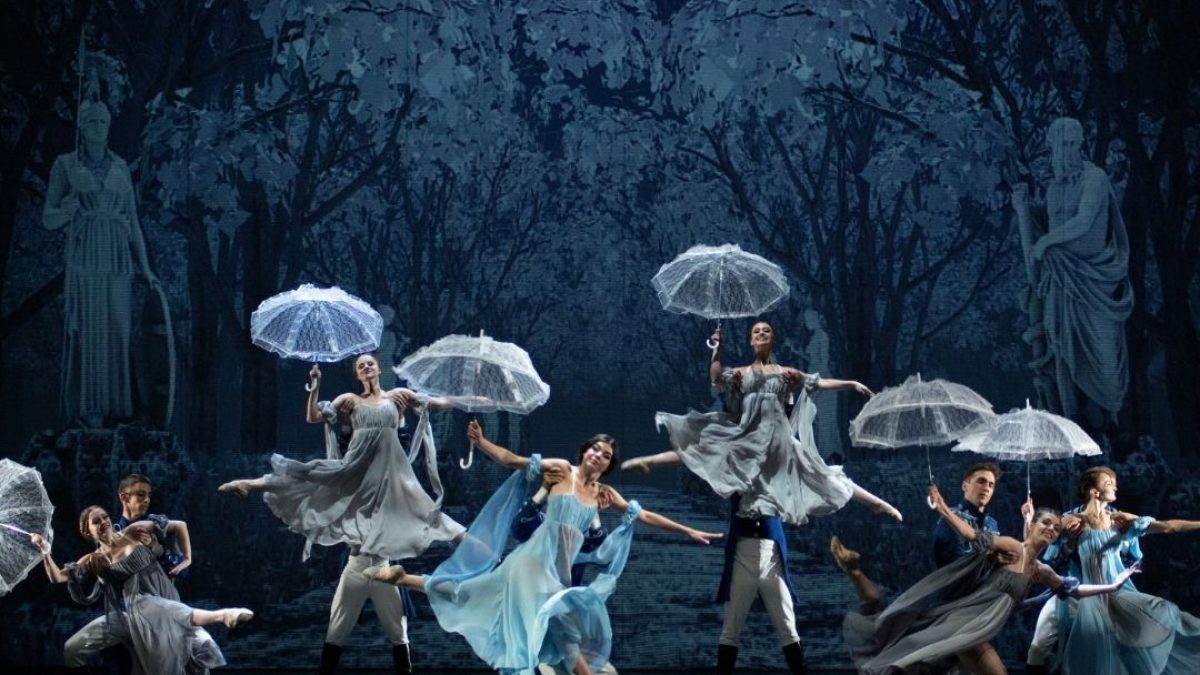
The spectacular appearance of the production is altogether captivating. The video projections with the moving statues of the Summer Garden and the mosaic combinations of cards (Olga Nikitina), the openwork parasols combined with other exquisite props (designers Taras Koretsky and Oleksandr Starov), together with the work of costume designer Dmytro Kuriata and lighting designer Olena Antokhina, confirm that with each of their joint efforts on Poklitaru’s productions, contemporary stage technologies acquire ever greater artistic meaning.
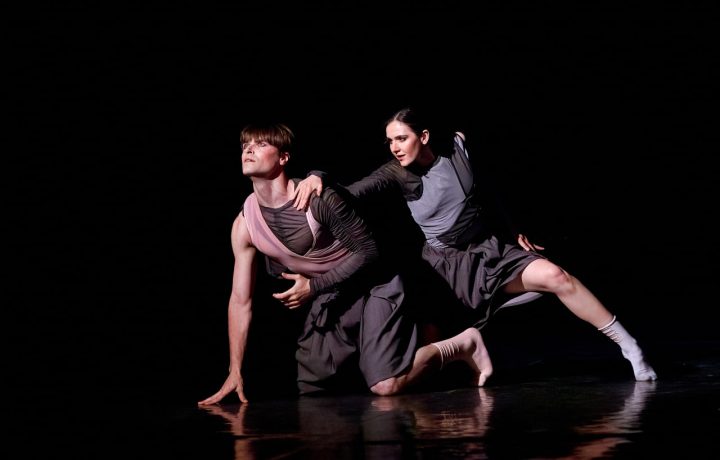
It is well known that Radu Poklitaru’s style is far from preserving an unshakable unity of place and time — he also handles space freely. And the plastic characteristics of the heroes correspond to universal human nature in any epoch. Thus before us appears the refined Man in Black, the insidious Count Saint-Germain, seductive and dissolute as the devil. In this leading role Artem Shoshin confirmed his remarkable acting versatility and confidently brought to the fore the theme of man’s dependence on the temptations of the Golden Calf.
And so happiness appears to Hermann (Vladyslav Detiuchenko), as earlier to the old Countess (Olena Saltykova), as possession of the secret of the three cards, that is, as a symbol of future enrichment and unshakable confidence in life. Yet the Three (Anastasiia Dobrovolska), the Seven (Daria Herashchenko), and the Ace (Illia Miroshnichenko), materialized by the choreographer — mocking and capricious — do not leave the ballet’s main «players» alone, leading them astray, whirling in inventive choreographic combinations. And in the end they achieve their aim — the Countess dies, Hermann sinks into madness, and the desperate and sincere Liza (Kateryna Kuznetsova) cannot save him from that addiction which is incompatible with true love.
***
The choreographic ensembles and duets are the true adornment of Poklitaru’s production, yet another testimony to the commanding power of his dance, which can halt an instant and can at the same time reproduce several polyphonic melodies in the production’s ingenious plastic score. Its finale is logical — the hero’s winning or the collapse of his hopes and expectations depends on heads or tails, contained on both sides of a coin. Or on the suit of the cards, where the black spearheads may reveal either the saving ace or the fatal queen of spades.
Oleksandr CHEPALOV, Honoured Art Worker of Ukraine
Den newspaper: No. 131-132, (2021)
Section: Culture