“Nine Dates”. A lovestruck drunkard, a baby and a leap from a window — in Radu Poklitaru’s new ballet
In the new production “Nine Dates”, the famous choreographer Radu Poklitaru checked whether it is true that truth is in a glass of beer, and that love is beautiful in all its manifestations.
In his new production "Nine Dates," the renowned choreographer Radu Poklitaru set out to test whether it is true that truth lies in a glass of beer, and that love is beautiful in all its manifestations.
The premiere of Radu Poklitaru’s new ballet "Nine Dates," performed by Kyiv Modern Ballet, has taken place. In it the master combined two one-act ballets — In pivo veritas (an ironic reworking of the Latin saying "In wine there is truth") and "Nine Dates." Although these two pieces are 23 years apart (the first was staged in 1998, while the second is a premiere), they are linked by the intriguing theme of love and alcohol.
Soaring drunkards and a stolen pointe shoe
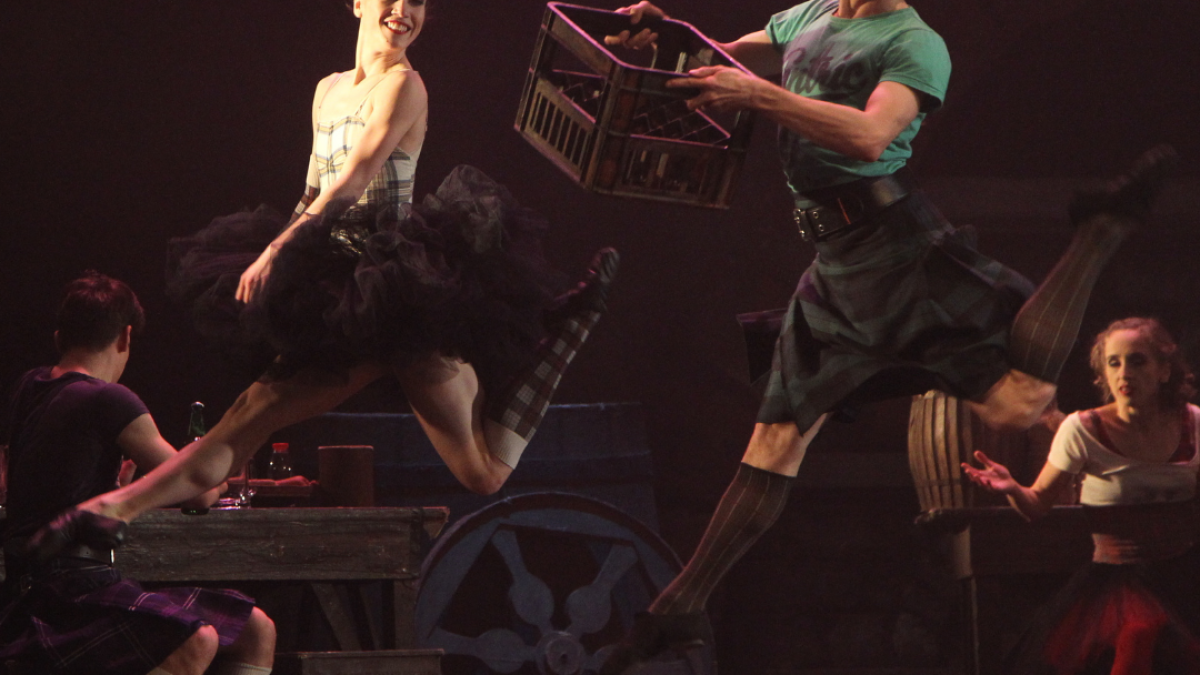
In the first ballet the action takes place in an Irish pub: all around, on sturdy wooden tables, sit beer mugs, kegs of beer, and strings of sausages dangling appetizingly down.
Several couples are feasting: lads in tartan kilts and girls in multicolored tutus.
A fair-haired young man begins to dance to Irish folk songs so fervently that, abandoning their own partners, other men’s beautiful ladies join him in the dance. At last the enraged suitors challenge the brazen fellow to an alcoholic dance battle and execute dazzling steps. Technically, Poklitaru’s dancers have reached an incredible level — it seems his lads literally hover in the air.
At a certain point they invite a Scottish soldier with a sword, who has fallen asleep at a table, to dance: the drunken warrior can barely manage his weapon as he performs fantastic capers. By some miracle he does not strike anyone with his fearsome blade, including a ballerina who appears out of nowhere. A local barefoot lass has stolen one of her pointe shoes — a ballet slipper. Once she puts it on, she instantly rises above everyone, like some flying fairy, and shows her drinking companions a real dance "blowout."
It was full of drive, fun, and fervor, but for me it lacked the dramaturgical touches that abound in the premiere production.
Variations on the theme of love — in the language of ballet
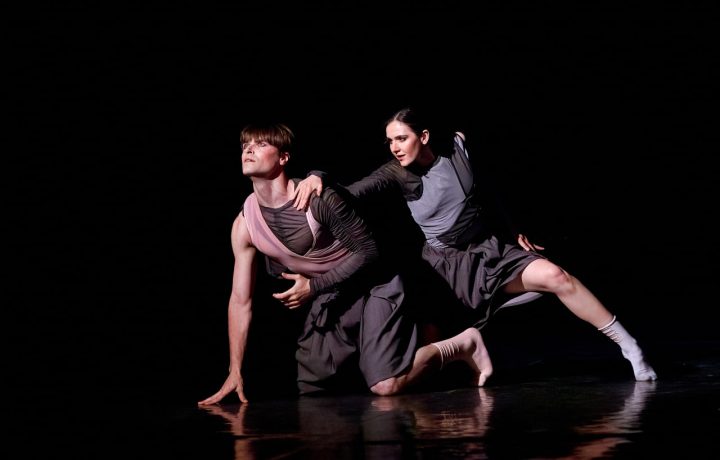
"Nine Dates" presents different versions of entirely familiar love situations, from the grotesque to the tragic. The dancers wear original black-and-white urban costumes. The action unfolds to the poignant music of Frédéric Chopin, which seems made to illustrate the experiences of love.
Through his charges, Poklitaru skillfully conveys the action of that electric current of sensuality that arises in people on a first romantic date. From it come awkwardness, shyness, and the bouquet of flowers "that gets in the way." An unknown energy gradually swells from within, making movements clumsy and turning the cheeks red.
The audience laughed most during the moment with the lovestruck drunkard who courts a girl without ever putting down his bottle: with his left hand he holds the bottle to his mouth, while with his right he twirls his partner.
The lovers’ embraces grow ever more passionate, and she is ready to give herself to him right there on the table, but at the most crucial moment her suitor falls asleep. The amount of alcohol in his blood has proved incompatible with sex.
He sleeps on the table while she, sitting on a stool, gloomily takes a pull from his bottle.
Another delightful episode was the one in which, while a young man is on a date with a lady, another young man shows up and leads him away. You should have seen her bewildered expression as the pair of men, arm in arm, left the apartment.
It is worth noting that the set is minimalist: a white table, a chair, and an open purple window. It was through this window that a man threw himself when our heroine held out an infant to him — he clearly was not yet ready to become a father.
Interestingly, against the backdrop of the various couples’ adventures (all portrayed by the same performers), an old woman kept walking about the whole time — perhaps Death, perhaps Old Age, perhaps Wisdom. You can interpret this figure however you like, but she brought a bitter irony to all the versions of love relationships on display.
The most touching was the date of a blind young man and a girl, especially when she began to feed him. And the most tense were the relations in which each of the lovers had a rope tied to their back, by which they were dragged apart from each other.
It was amusing when romantic relations abruptly turned into marital ones: when she immediately points out his direction of movement not only with her hand but also with her foot, so that he definitely makes no mistake about where to go.
The show-ballet ended with a triumphant ten-minute ovation for the maestro and his performers — the audience recognized themselves in this whole intoxicating-amorous palette.
Kostiantyn Rylov