For the first time in his theatre’s history, Radu Poklitaru presented an online premiere of “The Little Prince”
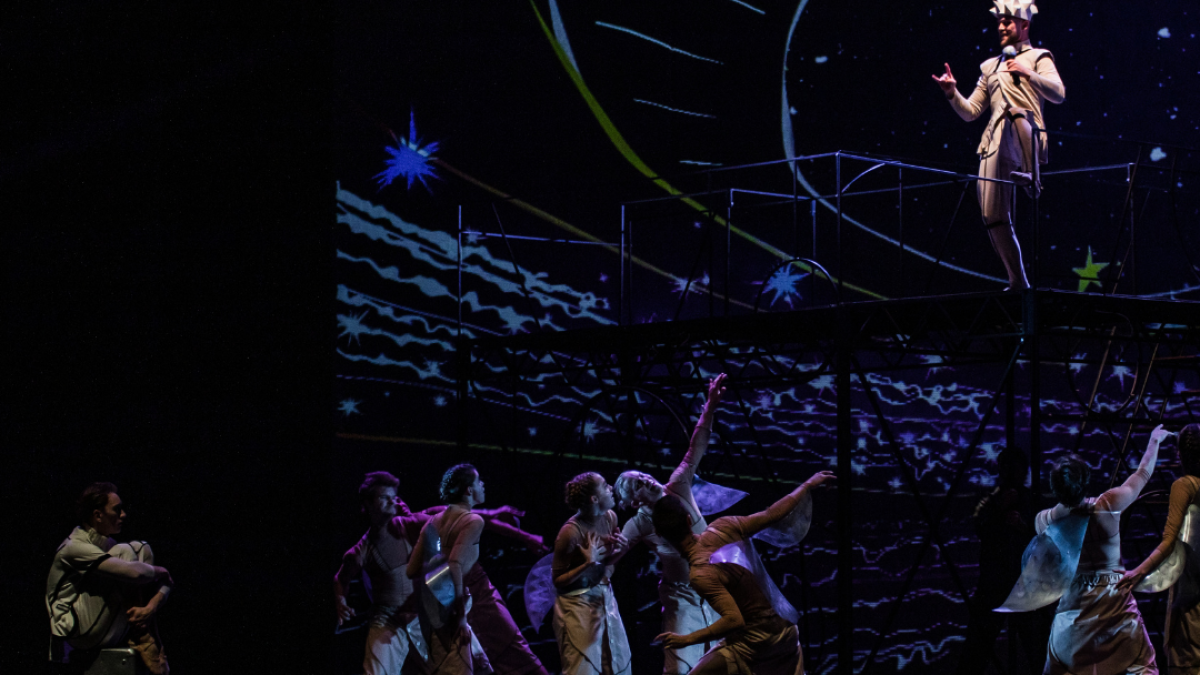
The ballet was staged to music by Mozart and Ukrainian lullabies.
On 21 October, a historic event took place in the life of Radu Poklitaru’s popular theatre “Kyiv Modern Ballet.” For the first time, the new production “The Little Prince” was shown to the widest possible audience — online and free of charge. Theatre critic Oleh Verhelis watched the production and shared his impressions and the hidden meanings of the new staging in his Telegram channel.
At the heart of the production lies a new reading of the well-known story of the Little Prince, of his understanding of the value of the relationship between two individuals, where every journey to a new planet is a profound insight into the essence of personality. It is a story about the superiority of simple things and values over the vanity and complexity of the “world of grown-ups,” about the significance of childhood as the principal period of human life. The ballet was set to the music of Mozart and Ukrainian lullabies.
“This production is not nearly as sweet to the taste as one might expect from a movement-based story about a philosopher-prince who saves his little planet from treacherous baobabs and knows the price of great friendship.
During the time this ballet was being shaped, the world and the planet found themselves captive to the latest mutating baobabs — a terrible lichen, the dreadful coronavirus, girdled our planet, turning life into a capricious pandemic reality.
That is why a hint of today’s bitter chocolate is present in Poklitaru’s new ballet too. Not literally and not visually. In this new ballet story, on the contrary, there is a kind of quiet sorrow. Not along the lines of “we’re all going to die”… But then again — where are poor earthlings to find some new, ideal planet for their quiet happiness, if the old planet, judging by the news feeds, has seemingly already exhausted its humanitarian potential.
The Little Prince moves about the stage, through space and time, meeting his old friends — the Pilot, the Fox, the Rose, and others. The trajectory of the story’s flight has not changed, but the circumstances in our Cosmos have.
In the premiere ballet I perceive the Little Prince as far from a cute, sweet, inquisitive child with wide-open eyes… In the new ballet, accordingly, the hero has grown up too. He is far from a sincere, sweet, naïve child, but a slender, well-bred teenager in the period of his late puberty. And he already WANTS a great deal… He wants not only to learn the signs of Infinity (like Zemfira in her song), but to learn something else as well, the thing teenagers of that age constantly think about as they drill their phones with the appropriate videos…
The Little Prince has already grown up — Poklitaru seems to hint. And his dreamed-of planet has also grown old — the author of the project seems to hint. And what, then, remains?
What remains is a beautiful dream of the past, of yesterday’s idealism, optimism and naïveté… Yes, we truly are responsible for those we have tamed. But the tamed, too, can in time turn into monsters. The sleep of a dream sometimes gives birth to monsters of its own.
Poklitaru himself, long before the production, spoils the secret of his ballet when he announces an important musical component of it — Ukrainian lullabies. If one wishes, this new ballet can be read this way too: the young Prince dreamed of good times, when he was still a little prince, when the world around him was different and the encounters more interesting… In the ballet such a device is expected and entirely possible, 100%.
On the whole, the premiere Little Prince by Radu Poklitaru is a syncretic and egocentric project. Syncretic — through the combination, within a single choreographic text, of disparate elements, both kindred and antagonistic. To Radu Poklitaru’s recognisable choreographic style are added… certain elements of puppet theatre (some characters are conceived as marionette puppets), elements of animation, computer graphics, and then there are the Ukrainian lullabies (as a separate yet kindred planet to this story), and of course there is also the music of the very young Mozart, which in the production sometimes dominates the choreography, as if breaking through to the foreground, when you want only to listen and to watch a little less (forgive me, but that is why he is a genius, Mozart).
Poklitaru’s choreographic style, precisely in The Little Prince, is distinguished, to my online eye, by a certain convulsiveness (from the word “convulsions”), figuratively speaking. And this, by the way, also fits the probable concept of an ailing world that the once-little Prince wants to forget in his dream.
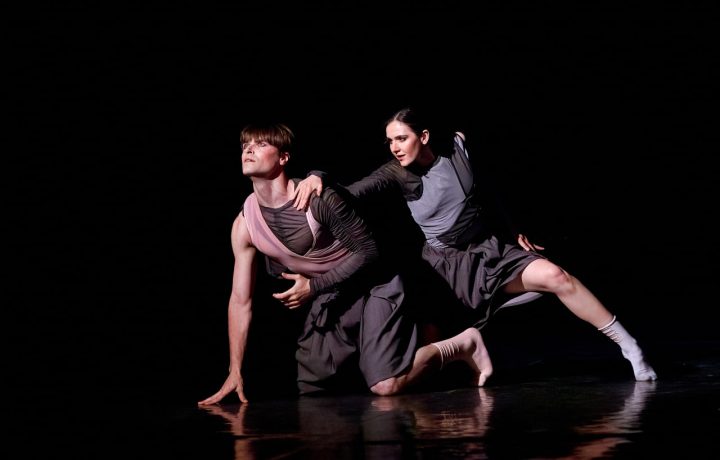
The choreographic score is sharpened by the director through the duet scenes. The Prince and the Fox, the Prince and the Rose. Such scenes are realised convincingly, emotionally, sharply, distinctively. I can just imagine how the author would have liked to let out, in separate scenes, his grotesquely sharp thorns, of which he is a great master. But I see how he restrains himself. There are enough thorns around as it is, so here the matter is the petals of the Rose.
I am no eminent, titled Poklitaru scholar in our art milieu, but I take the liberty of noting that The Little Prince is Radu’s most personal ballet. The most egocentric. He stages it about the Prince, but he thinks about himself. This is revealed in the choreographic decisions too, when the Author (the director) constantly chooses to assert his priority over Exupéry, over Mozart, over the Prince. That is, for the choreographer this is a rather personal story. A recollection of the dream of his own childhood, when, for instance, he would hide from his teachers in his Chisinau school, covering himself with a metal washtub… And those washtubs from the past are also his childhood planet, a shell against the everyday, protection from the baobabs,” Verhelis wrote.
Oleh VERHELIS
ZN.UA