A “Conversation” about tolerance
“DiscrimiNATION” is a new work by Radu Poklitaru and “Kyiv Modern Ballet”.
The productions of Radu Poklitaru are always a quest, a puzzle — especially when it comes to plotless works whose themes are defined by philosophical categories that are not merely illustrated but interpreted in the language of dance.
My expectations for the title of the work were not met, because I read into it the stereotypical modern understanding of the concept of «NATION», set off in the title in capital letters. But Radu Poklitaru never does anything by chance. So I had to search for a deeper etymology and the direct translation from Latin, without the subsequent ideological and political layers that today give rise to that immediate association. Thus, literally, natio means kin, tribe — any tribe at all. Let us take it as «the human race».
The choreographer explores the global theme of discrimination through examples of its manifestations in everyday life, the kind we may encounter every day. Why do people, in their rejection of what is different, what is other (sic! i-natio), reach the point of hatred and the wish to destroy? We absorb examples of discrimination from childhood, from fairy tales: the ugly duckling, Cinderella… We sympathise with the heroes who are discriminated against by their «antipodes». And then we grow up, accumulate the stereotypes imposed on us by society, and become prejudiced and recklessly aggressive towards «deviations».
The reason for the lack of tolerance towards certain phenomena lies solely in upbringing, in the imposition — on various levels — of certain stereotypes of individual behaviour in society as the only correct ones.
The path to genuine, sincere tolerance of differences lies through the capacity for critical thinking. But there is also the dangerous path of mimicry, when, on an emotional level and under the influence of agitation, people suddenly take on qualities they had previously rejected. Freedom — especially for societies that have only just emerged from regulated totalitarianism — is too complicated a gift, and for some an entirely unwelcome one. Yet on the road towards a democratic world, one ought to learn to «make use» of its values, rather than barging into it carrying one’s own «samovar».
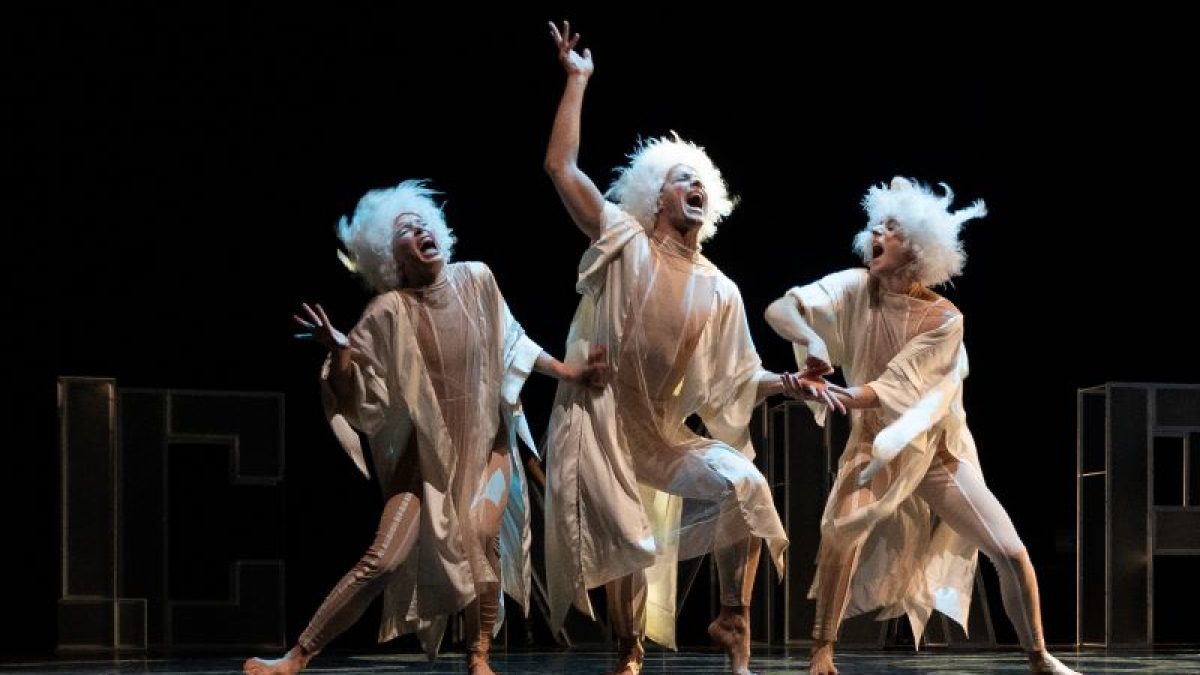
The series of short parables in the production «DiscrimiNATION» invites viewers to examine and reflect upon several kinds of discrimination. In each situation, the pendulum of emotional gradations swings to its extreme values — a full 180 degrees, plus-minus, minus-plus… The wave and the pathos are each time somewhat deflated by the comical and ironic Angels, who here are not guardians at all but rather observers and commentators on the events. The musical material again employs music that is diametrically opposed in its emotional effect: the surging choruses, arias and symphonic fragments of George Handel, which convey the entire spectrum of feeling, and the therapeutically soothing piano bagatelles of Valentin Silvestrov.
In the laconic yet profound scenography of Oleksandr Bilozub, the principle of forming anagrams is employed — the making of new words out of another word. Throughout the action the word «discrimination», whose letters are in fact the set design of the production, is constantly reconstructed into other words and meanings, which in turn comment upon one or another parable-tableau. At the very start the letters are chaotically heaped into a great pile: a rubble from beneath which people are scrambling out (a piercingly topical image of our present day as a symbol of the discrimination of one people by another, although this theme is not developed further). When the characters arrange the letters in accordance with the title of the production, it becomes clear that they are all — figurative victims of various forms of discrimination.
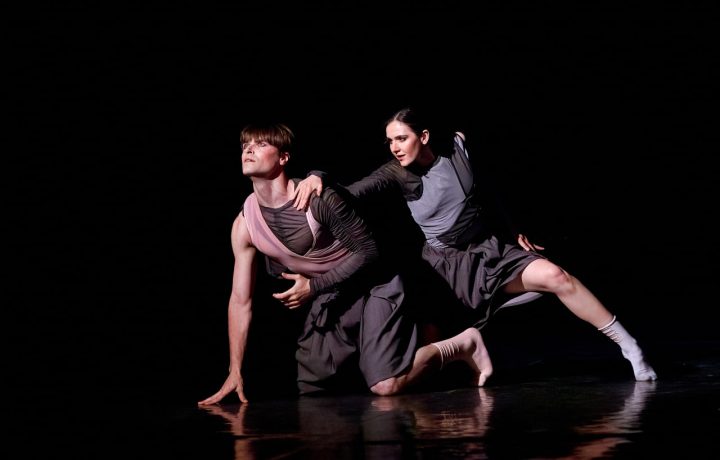
In the parable «Love», the pendulum first races headlong, then «stalls» at several points: there is a stereotype, there is a deviation and a sharp negative reaction to it, then — its toleration and the gradual mass conferral upon the «deviation» of the marks of a new stereotype. Everything is turned upside down! This appears to be one of the most difficult and most heated themes of our time, and so it is scenographically prefaced by the ambiguous and unfinished word «deed» and the hidden «aria», which in its direct meaning signifies «air». And indeed — love is the air of human life. But in the understanding of an aria as a solo song there is also a transparent hint: it is great happiness when two arias merge into a duet, and when no superfluous third party wedges itself in… Choreographically the piece is resolved through a combination of mobile pantomime and «modernised» classical arabesques and lifts, which the choreographer traditionally strips of their refinement, lending them a coarse physicality and earthiness, as if caricaturing them — closer to the Kama Sutra than to the encyclopaedia of classical ballet.
The piece «Age» explores the problem of the incompatibility of youth and old age. The choreographer offers no solution; he draws attention to problems that have no simple answer. Towards old age, respect is fully proclaimed, yet quite often what is voiced is a condescending disdain, an ignoring. The anagram «Nation» probably symbolises age as the sum of the marks of a lineage — with memory, experience and traditions passed down from generation to generation. Having fulfilled its task, the progenitor, by a natural or a prompted path, departs the active stage of life, pushed aside as a helpless onlooker.
«Madness» is depicted as an epidemic emotional phenomenon, when the first reaction is mockery, yet suddenly the people who had just been «normal» gradually become captivated by the mad idea and lose their sound judgement, consumed by mass psychosis. Can madness be a dream? Why not? When the burden of conventions, responsibilities and prescriptions tightens the boundaries around the individual, the absolute freedom of mad-will may indeed become a dream.
The «white crow», in all ages, is a symbol of diametrical difference from the majority, an object of attacks and mockery, but also of a hidden curiosity born of incomprehension and therefore of a wary apprehension. In the solution of the artist Dmytro Kuryata, the white crow is bright red, and the anagram conveyed to her is at first unexpected, but in essence undoubtedly correct — mission! (Incidentally, as always, the artist creatively designs interesting and recognisable costume-images, creating not a gallery but a palette of characters.)
The piece «The Guide» dissects one of the most dangerous forms of discrimination — power and… everyone else. A leader or a tyrant? A guide for a blind person is good, because necessary, although without complete trust it is also a question of where one will be led. A leader for an active society capable of critical thinking is more or less the norm, at least in organisational terms. A guide-leader for a blind society, capable only of dreaming of a happy future painted by someone else, is, as a rule, a catastrophe.
The umbrella, as a symbol of power: while it is open, beneath it all is secure and calm. But when it is folded and turns into a pointing staff that sets the direction of movement for the obedient herd — to the abyss, then to the abyss it is. The thoughtless toleration of uncontrolled power leads society to catastrophe. And «hope», rather than firm conviction, is in truth a very unsteady support beneath one’s feet. When illusions collapse, hope dies — last of all. And with it everything vanishes; a person is left alone with himself. In any situation, save death, the «I» remains. When the I vanishes, the world vanishes. When there is an I, there appears hope, a dream, a mission…
If in the Ukrainian language the word «discrimination» were written according to its transcription — diskriminatsiia (from discriminatio) — then in the finale the letter and the concept of «I» could be commented upon with the anagram «initiation» — a beginning, a step towards… Towards what? Towards understanding? Acceptance? Mutual understanding?
Handel said of his music: «I should be sorry if I only entertained people. My goal is to make them better». Poklitaru, in all likelihood, pursues that same humanistic goal, arming himself with the fine scalpel of a surgeon rather than the axe of an executioner. An important component of critical thinking is often the capacity for subtle irony rather than for the devastating dramatisation of events and phenomena. «Only by speaking openly about a problem can we fight the evil embedded within it.
Seriously and with a smile, tragically and ironically. But to speak freely and frankly». The conversation has taken place! A very important conversation...
The project «DiscrimiNATION» of the Academic Theatre «Kyiv Modern Ballet» was created with the financial support of the Ukrainian Cultural Foundation.
Larysa Tarasenko
Music-review Ukraine