Radu Poklitaru stunned with premieres of a show where Russia is the past and Ukraine the future
The leading Ukrainian choreographer presented the premiere show-ballet “Tomorrow” about Ukraine’s future and revived the production “Up the River”, staged before the war.
A double premiere by Radu Poklitaru at the International Center of Culture and Arts (October Palace). The master managed to "reboot" his pre-war ballet "Up the River" and present to the public an entirely new one — "Tomorrow".
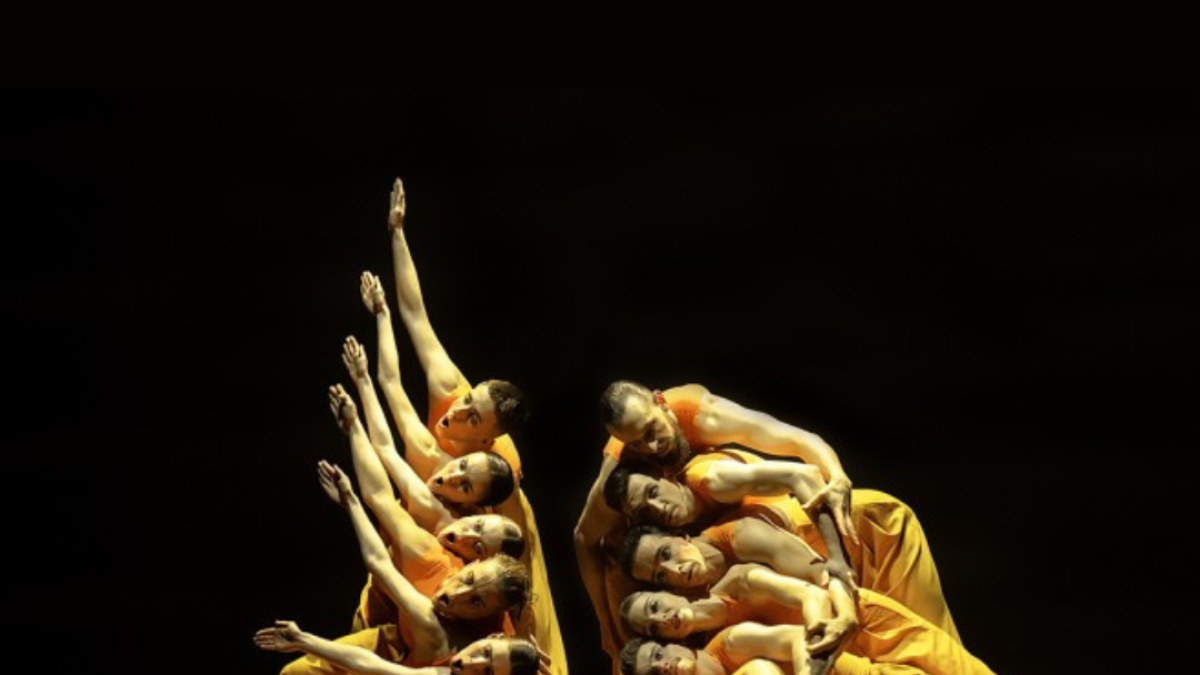
The first was based on "The Curious Case of Benjamin Button" by Francis Fitzgerald. Through Poklitaru’s efforts it has been reworked into a modern version of "Faust". An old man strikes a bargain with the devil that he will grow younger, and from there a host of adventures unfolds as he journeys in reverse — toward the cradle. "Tomorrow" is the master’s free fantasy on the theme of the Ukrainian people. Two dozen dancers in yellow-and-orange costumes portrayed the people as a single organism: many-armed, many-legged, many-faced. The "people" did everything in a single impulse: from a military parade to lulling a child to sleep.
The first show ballet is in blue and violet. The second is dominated by yellow and orange. Together they form the Ukrainian flag, and with this double premiere the choreographer seems to be saying: his work lives on and continues in the homeland. It is known that many ballet artists left when the war began, but Poklitaru manages not only to revive old productions but also to deliver fresh work with the renewed company of Kyiv Modern-Ballet.
In these premieres Poklitaru revealed himself from an unexpected side. There are no grand sets here, as in "Swan Lake" and "The Nutcracker". Here there is minimalism plus the synchronicity and expressiveness of the dancers. But the master’s chief weapons — metaphors and transformations — are present, as always.
Time in Reverse. Radu Poklitaru’s ballet "Up the River"
First, about the opening performance. Everyone remembers David Fincher’s film "The Curious Case of Benjamin Button" (2008) with Brad Pitt and his incredible makeup, as he gradually transformed from an old man into an infant — for which the creators won an "Oscar". The film was based on Fitzgerald’s short story, published in 1922. They say he took the idea from a line by Mark Twain: "Life would be infinitely happier if we could only be born at the age of eighty and gradually approach eighteen". The hero is born a 70-year-old who can already speak, and then grows younger, all the way into childhood.
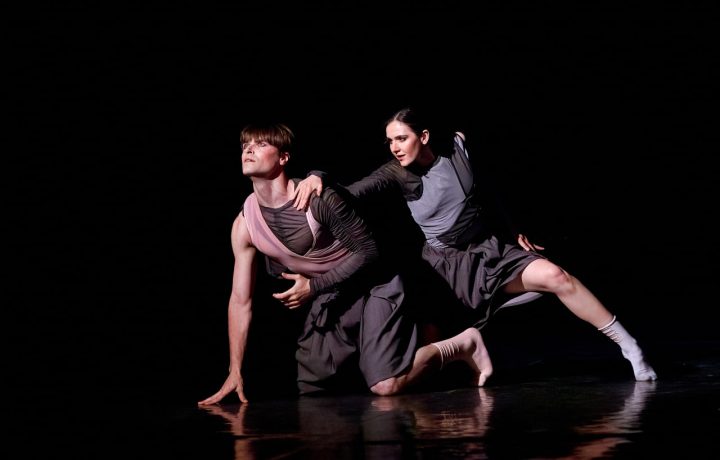
Neither the film nor the story showed us the reason for this paradox. Poklitaru invented a mystical backstory: an old man beside a coffin makes a contract with the devil (the Man in Black) that he will receive a second life, but — backwards. The price, presumably, is his soul.
At the back of the stage is an enormous clock running in reverse, as in the line by Boris Grebenshchikov: "It may come to pass that the hands of the clock will begin to turn backwards".
The hero acquires a beautiful wife, a daughter is born — he merrily whirls across the stage with them. Before long he will also take a mistress, denying himself nothing.
He cuts loose to the fullest, returning into the past, but the devil watches all his escapades with mocking calm, biding his time.
The wife has aged and grown stooped under the weight of the years, the daughter has grown up and gone, the mistress has vanished. Those close to our hero begin to disappear around him. He becomes a boy, and the Man in Black draws ever closer to him.
And here, perhaps, comes the most moving moment of the show: the devil seized the boy and began to move him horizontally, parallel to the stage, as if hastening the inevitable end. And then he spun him like the hand of a clock — the violins sang out plaintively (music by the Ukrainian composer Oleksandr Rodin).
Now the protagonist is a swaddled babe in the devil’s arms. The Man in Black shakes out the swaddling clothes, from which ashes spill, hanging in the air as a grey little cloud. Finita la…
Seeing this attempt to turn back time, one is reminded of our northern neighbours. This absurd urge to bring back the Soviet past, to recreate the USSR — like Russia’s insane attempt to reclaim its childhood (half the Russian film websites are reporting news from 40 years ago, about how Gaidai quarrelled with Morgunov) — can end in nothing other than a fatal outcome.
Ukraine, by contrast, with its powerful resistance and counterattack, has pushed time — forward!
And it is about this — the show ballet "Tomorrow".
Unity. A show ballet by Radu Poklitaru
"We are now living in a difficult time. It is hard to find a theme that would resonate emotionally with what the entire Ukrainian people is going through. And do we even need to look for one?" the master mused in the press release. But in fact he found this theme and presented it — to the music of Frédéric Chopin.
That theme is unity. The dancers in yellow-and-orange costumes performed dozens of mesmerizing synchronized movements
Now they all seem to be rowing together.
Now together they rock an infant in a cradle.
Now together they build a pyramid.
Now together they pound out a step in a military march.
Then, raising their hands, they drink in the rays of light
And after this, rope ladders fall from somewhere above and the artists climb higher and higher, toward the heavens, the sun, the dream.
We will hold out, we will endure, we will achieve victory and build our sunlit world!
As for technique, Poklitaru surprised in that, on the one hand, his Kyiv Modern-Ballet has borrowed a great deal from the Dutch Nederlands Dans Theater — this very synchronized movement of dozens of people.
And on the other hand, from all his dancers he builds unusual, unified images — and this is more characteristic of the Eastern school of dance — Chinese opera, for example.
Radu Poklitaru managed to synthesize the trending technique of the West, multiplying it by the philosophical approach of the East. The result is the Ukrainian ballet of the future!
Text: Kostiantyn RYLOV