Radu Poklitaru: “I create my own world because I can’t do anything else”
The master of choreography surprises the audience every time with his stunning creations; viewers ask a natural question: “How does he do it?”. Also about the new season premiere “DiscrimiNATION”, realised with the support of the UCF — and not only about that…
The master of choreography never fails to astonish audiences with his stunning creations, and viewers are left with a natural question: “How does he do it?”. The desire to open the door of his creative kitchen even a crack brought Kyiv Daily to the Kyiv Opera on Podil.
To what extent did the war put your creative process on hold?
— It rather transformed it. For the first couple of months there was, of course, a complete halt, and then it resumed — it simply took on a different format. Before, it was only the Kyiv Modern Ballet theatre. Now numerous and varied European theatres have been added. Diversification of risks.
Is it only you who works this way, or do your artists do so as well?
— I stage productions at various theatres, and the artists take part in various European concerts. And I constantly come back to Kyiv, where I make new productions.
And in which countries?
— In Bulgaria, Latvia, the Czech Republic, Croatia. So far like this. New projects keep appearing. There are mega-popular artists whose schedules are mapped out 10 years ahead. For me it is enough to have plans a year in advance to feel more or less emotionally at peace.
What productions are there at the moment?
— Different ones. There are two versions. They are either revival productions — from my old ballets — or, in particular cases, I am asked to make something new, and I do. Right now, for example, I am working at the National Theatre in Brno, in the Czech Republic, with a wonderful ballet company. There will be an evening of one-act ballets, and, besides the work of your humble servant, there will be productions by two giants of contemporary choreography – Ji’rí Kylián and Nacho Duato. They, of course, do revivals, while I was told that I had to make a new production.
And what are you doing?
— The ballet is called “Waves”. Set to a blend of the music of Johann Sebastian Bach and a Ukrainian folk a cappella song. A little “gem” lasting half an hour.
You use works by the classics quite often in general.
— Classical or folk music. I have no other inspirers among music. Perhaps, in addition, a good-quality bard song. But that is the maximum. Unfortunately, pop music, variety music and the like do not arouse any creative erection in me.
And jazz?
— Jazz is one of the gaps in my education. I like Armstrong, Fitzgerald, but that is all. Contemporary jazz I do not understand at all, because I do not know it.
Which Ukrainian composers do you like?
— I have had repeated creative connections with Ukrainian composers. In our time, together with Myroslav Mykhailovych Skoryk, we made the grand ballet “Crossroads” on the stage of the National Opera of Ukraine. Myroslav Mykhailovych was at the conductor’s stand for his three violin concertos, and they were played by three virtuoso violinists of Ukrainian origin from various countries of the world. A very charming co-production of the Kyiv Modern Ballet and the National Opera of Ukraine. To this day many people regret that it is no longer performed. But a co-production has very little staying power, because it is difficult to coordinate the work of two different theatre companies, or of an orchestra and a company. But it was a project I am proud of. And to work with such a maestro as Myroslav Mykhailovych is a great honour for me. He expressed a wish to work together again, and had it not been for his death, more of our joint works would have appeared.
Many productions with Oleksandr Rodin, and I want to keep working together. He is my friend (Sasha, forgive me, may I call you a friend? Otherwise you’ll say I am being too familiar). We made the production “Up the River” based on Fitzgerald’s story about Benjamin Button. And especially for me personally Oleksandr wrote the ballet “Viy”. It is being performed by us now, and recently there was a premiere at the Latvian National Opera in Riga. A legendary theatre!
How is it received?
— Immediately after the premiere all the tickets were sold out to the end of the season. Their season closing was on 16 June, and there was not a single free seat. So — it’s good.
Was this production not made with the Kyiv Modern Ballet?
— Yes, in my time I made the production for the Kyiv Modern Ballet theatre as well, and then a commission came from the Latvian Opera to transfer this production there. In Kyiv we work to a recording, while there it is only a live orchestra. And this is a huge problem, because the production is built, in terms of stage design, on video projection, and it requires constant, perfect synchronisation of the video sequence and the sound of the music, while with a live orchestra this is incredibly difficult to achieve. So the main problem was not a choreographic or a musical one, but precisely a technical one – how to synchronise it. Now I know everything about this. And the second thing. The company at the Latvian Opera is much larger than that of the Kyiv Modern Ballet. So Aivars Leimanis, the artistic director of the ballet in Latvia, asked me to enlarge the cast. A grand version is performed there.
Against the backdrop of the terrible events now taking place in Ukraine, many creators are making, as they say, works “on theme”. Did you not have a desire to create something similar?
– I have never had a desire to be as topical as possible. I simply cannot, probably. If my colleagues are able to create a ballet on a directly topical subject, I just take off my hat. Well done! Ballet, it seems to me, is not very journalistic in itself. It is more emotional, more generalised, more symbolic, allegorical. And in order for a symbol of allegory or a metaphor to arise, time is needed, distance is needed. My first wartime production is “Tomorrow”. The premiere took place in the month of March.
This year?
— Yes. So here’s the thing. I even thought about asking the artists who have children to record on dictaphones children’s reflections about what tomorrow will be for them. And to use this as a vocal accompaniment to the dance together with the music of Chopin. I often pull out of my favourite stashes treasures I have laboured over for a long, long time and did not want to give to anyone. And I waited, and waited, and waited. In the end I realised that I will soon be 52, so I have to spend them somehow, there is no need to hoard them. Chopin’s music truly is brilliant. And when I had already come right up to creating the production, I suddenly realised that the children’s voices were a cheap trick. So only Chopin remained.
During your production the artists do not simply dance, they make various sounds, they yelp, they roar with laughter
— For contemporary choreography this is absolute mainstream: they talk, laugh, cry, scream, give birth to children. Nothing special. It is not my invention. In classical ballet everyone is silent. What is more, the majority of classical ballet artists have an incredible acting block. If you ask them to say something, or to laugh, or to cry, they cannot do it, because for nine years at the school they are taught to look at themselves silently in the mirror. Maximum silence in the hall. And so I had cases of outright hysterics, especially among the girls — they simply cannot do it physically, psychologically.
And did you not have a desire to make a ballet without music at all, based on emotions?
– As an option — perhaps. But I love music very much. It helps me, it is my support. If I fall short with the choreography, the music will still save it, provided it is good. And who is there to save me?
Do you always start from the music?
— It varies greatly. If there is a story, I start from the story. If there is music, I start from the music. Right now Chekhov is banned. But before the war we performed an evening of one-act ballets — “Ward No. 6” and Underground. And in this evening the diametrical difference in the first source of inspiration for a production is vividly displayed. “Ward No. 6” was definitely Chekhov first, and then I realised that it would be good to use the music of Arvo Pärt for it. While in the ballet Underground it was the brilliant violin concerto by Pēteris Vasks. And it was to this concerto that I came up with the story. There are no rules, thank God.
Tchaikovsky is now banned too.
— Any Russian culture is banned. It is very difficult to come up with rules that would work all the time. Before the war Prokofiev was considered a Ukrainian composer, because he was born and spent his childhood on the territory of Ukraine. Donetsk airport was named after Prokofiev. Now for some reason he has been classed among Russian composers. Gogol, who wrote in Russian, is for some reason Ukrainian. That is, on this subject one can argue endlessly. Aram Khachaturian is banned. It is clear that he worked in Russia, but he was an Armenian.
Yes, my point is that you have many ballets set to Tchaikovsky’s music.
— I am simply sitting on the riverbank and waiting for the current, perhaps, to change and for passions to subside. Perhaps one day Tchaikovsky will be rehabilitated and someone will say that he had nothing to do with the attack on 24 February. But I am not pressing the issue, I understand the situation: right now it is definitely not the time. And I can calmly live through this, although, as far as I am concerned, the productions are good. But I am a person who is, for now, capable of generating new choreographic productions.
An acquaintance of mine told me that once he went to your ballet after a working day and was already prepared to fight off sleep. But when he started watching, he simply had an epiphany. And, without tearing himself away, he watched the entire production. Do you consider yourself a person who changes the world?
— No, I consider myself a person who creates his own world. Any artist, depending on how much talent God has allotted him, always creates his own world. A little less, a little more, a little more interesting, a little more boring, a little more colourful, a little more monochrome, but each time it is the world of that artist. I simply create my own world, because I cannot do anything else.
In one interview in 2019 you said that, unfortunately, culture is not a priority for the Ukrainian state. Has anything changed in that time?
— No, of course not.
And you see no movements at all in this respect?
— Right now there is simply a movement of support for Ukrainian culture, which is, in principle, correct. But I believe that support for Ukrainian culture should have come much earlier. Perhaps then the mentality of the nation and everything else would have been formed differently. But we have what we have. And right now everything is directed towards the war, which, in principle, is entirely understandable. The Armed Forces of Ukraine and the counteroffensive – that is our everything.
Creative people are in a constant state of searching and learning. What are you learning right now?
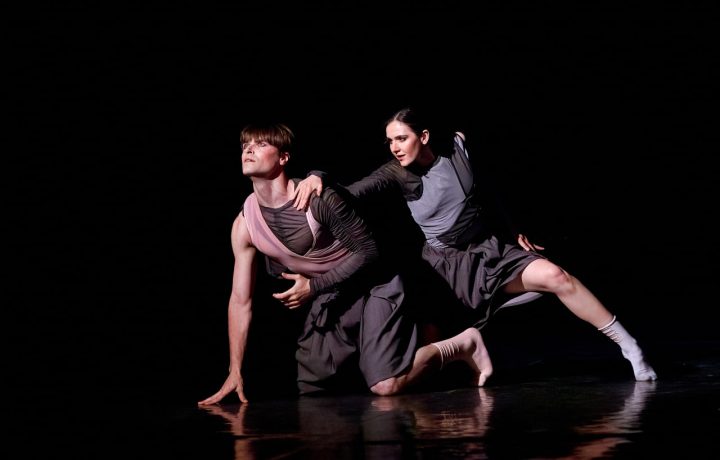
— I do not know, I am not learning anything in particular. When I stage a new production, I am in a state of turmoil and self-doubt. When I was a young choreographer, I was always sure of myself. But now, having staged over 50 ballets, it seems that whatever I do in the rehearsal hall has already been done, is no longer interesting, and I am repeating myself. And so it is every time, from the start of a new project. I now honestly admit to the artists that I am in a panic. And we begin to create something together. Just now several rehearsals took place of a new production called “DiscrimiNATION”. We won a grant from the Ukrainian Cultural Foundation, we began work on the production, whose premiere will be on 21 October. And here I am, breaking through the music of Handel and Valentyn Sylvestrov and breaking through my own self-doubt. This is normal. I think the moment self-confidence appears – that’s the end.
Are you very protective of your idea, or do you allow others to be interwoven into the process?
— I simply demand that others be interwoven, because I believe that in the end it is for me to decide anyway – what goes into circulation and what does not. I honestly feed off the talents of the people who work together with me. This concerns the costume designers, and the PR manager, and the artist who designs the posters, and, of course, the artists with whom I am in the hall every day. They know that they can propose anything at all. Any artist who has only just joined the theatre can say: “I have an idea, may I share it?”. I listen, just in case — what if it’s something good?
Tell us about the ballet “DiscrimiNATION”
— For now there is not much to tell. It is a ballet in one act. The stage designer is Oleksandr Bilozub. Ukrainian audiences know him as the chief designer of the Operetta Theatre. That does not describe the full spectrum of Sashko’s talents. An incredibly creative, extravagant person. The costume designer Dmytro Kuryata is the former head of the style department of the STB television channel: all the “X-Factors”, “So You Think You Can Dance”, the series “The Serf” – that is all him. A young man with incredibly light creative energy. He and I have already created many productions together. The music is by Georg Handel and Valentyn Sylvestrov, our great master. I am very happy that he allowed me to use his music. With Handel one does not need to ask, but with Sylvestrov one does. This is my third turn to Ukrainian music after Skoryk and Rodin. I have finally grown up to Sylvestrov, and I hope I will not spoil anything. So I looked at all the possible creative clusters that exist there, and I realised that the only thing that can move me as an artist is the support of universal and pan-European values, the fight against discrimination, segregation, tolerance and so on. And I thought that if I am staging a ballet about discrimination, then the most logical thing is to call it “DiscrimiNATION”. What it will be is unclear, because it moulds itself and is unpredictable. You cannot invent it in your head. Hegel invented dialectics, the incompatibility of the ideal and the real. The ideal ballet that is in your head never coincides with the real production that appears on the stage. It is completely different. I now take this calmly and watch how it is born and acquires its features, which have nothing whatsoever to do with me.
How close is this subject to you personally?
— We have all encountered discrimination, it is rather many-faced. You, a little boy, are studying at a ballet school, and the senior pupils bully you – that is discrimination on the grounds of age. And so on. Throughout your entire life you encounter this in various forms. Rich – poor, healthy – sick, Moldovan, Jew and so on. In everyday life we constantly encounter this: someone rides a minibus, someone – a “Rolls-Royce”. Of course, when it reaches some critical magnitude – it becomes unbearable.
Why do men often perform the female parts in your work?
– Not often. It is just that sometimes a lot of women are needed, and I have only 11 of them. I put men into the costumes, then looked – it looks very colourful. I myself, by the way, performed female parts when, from 1991 to 2000, I worked at the Bolshoi Theatre of the Republic of Belarus. And I danced the fairy Carabosse, the evil sorceress Madge. These are parts traditionally performed by men.
Do you keep yourself in some kind of shape now?
– Unfortunately, I now have serious health problems. But I love walking with poles very much.
With poles?
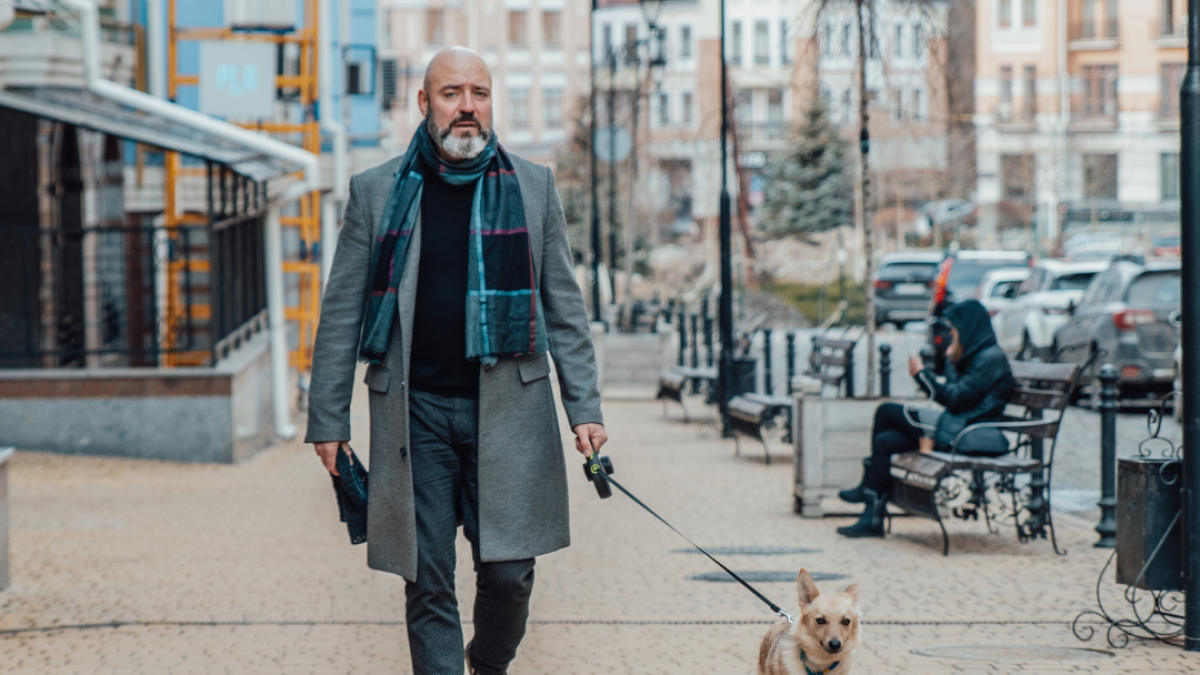
– Yes, Nordic walking. I really do walk a lot. I have a dog, the companion of these walks. It seems to me even he says: “Daddy, maybe that’s enough of this much?”.
A big dog?
– No. Literally just before the war I took a little dog from a shelter. 10 kilograms, a wonderful mongrel. He is usually always with me.
Even if you go abroad somewhere?
– He is constantly with me. In my car, behind, Rusty has an enormous special hammock for three seats. So that the fur does not fly about and he is comfortable. He can lie down, can walk about, do whatever he wants. An aristocrat dog in the back, and I — his driver. He and I have travelled a great deal. He bears everything well, he likes to travel. I have the best-behaved and most obedient dog in Kyiv.
Does he dance?
— He understands at half a word what needs to be done. I spent some time in Bulgaria, and there was a funny incident there. I am walking along the boulevard with the dog and approach a pedestrian crossing. And Rusty knows that when I have come up to a pedestrian crossing and stopped, he must sit down beside me and wait until I say that we may go on. Some elderly Bulgarian comes up (and in Bulgaria there are very many elderly people who are nostalgic for the Soviet Union) and asks: “Russia?”. I answer: “Ukraine”. And he looks at Rusty and says: “Good dog. Discipline. Stalin”.
Has the war changed you in any way?
— Perhaps I have become more tolerant. I now understand that the artists I work with need a little more warmth and understanding. Where before I tightened the disciplinary screws harshly, now I think five times before raising my voice or making someone do something and putting some pressure on, because things are already not easy for them. It is not a given that it always works out, but I try to be more humane.
Have you ever pictured yourself with a weapon in your hands?
– No. It is strange to say this, but I am now 51 years old, and I have never once fought with anyone. Even when I was a boy, when everyone around was fighting.
Is this a matter of principle?
— I do not know. I was enormous. The height at which I am sitting before you – one metre eighty-six – I was already at fourteen years of age. And the rest were small. And why fight, if you can simply take them, lift them up and hold them until they calm down? That was my form of fighting.
Which of your character traits do you consider the strongest?
— I am quite organised. Today I was driving to the meeting with you and was exactly one minute late. That is a catastrophe for me. I love to plan and do practically everything in Excel. There I have everything mapped out far in advance, even by a specific time. It then often changes, but I feel calmer that I have it. That’s all. There are no more good qualities. The rest — are negative (laughs).
What makes you happy?
— I love to travel. I love to gather mushrooms. I love to cook, but it has to be that I am alone in the kitchen, so that no one disturbs me. I, by the way, withstand solitude very well. I am never bored. Recently I spent 10 days in Romania, in Sovata, trying to heal my joints, my back. There is a wonderful place there – a geothermal mega-salt lake and beneficial muds. At first I thought I would howl: it is just the Transylvanian backwoods there! Enormous 20-centimetre bear tracks, wild boars running past … On the whole I had a wonderful time: me, the dog, the muds, the pool and a massage. That’s all, nothing more is needed. I sat there, wrote little ballets, little texts. Really good!
What will there be in the new season?
– In the new season there will definitely be the production “DiscrimiNATION”. Then — I’ll lift the veil of secrecy — I am going to make a new chamber production for four people set to the music of my beloved, brilliant Pēteris Vasks. The working title is “Friends”. It is being created on commission from the Pēteris Vasks festival, which takes place in the town of Cēsis. And I am thinking of giving Pēteris such a present for his birthday, which will be in April. The premiere will be there, of course. For now that is all. But we are still planning, I am not a monopolist and I willingly give the opportunity to stage to other people in the theatre. I think there will be more projects, in particular a New Year one and works by young choreographers. I do not even know what I am more proud of – that the theatre was created and continues to live, or that the overwhelming majority of the good choreographers of our country are graduates of the Kyiv Modern Ballet. A huge number of guys had the opportunity here, with these artists, on this very stage, to make their first attempts. Because for a young choreographer it is very important to show his work to the public. Otherwise he does not understand the feedback and cannot grow. I have always given such an opportunity, and I will continue to give it in the future.
Nataliia KRIAZH,