Cards, a mirror, two lovers. Premiere of Radu Poklitaru’s mystical-erotic ballet “The Queen of Spades”
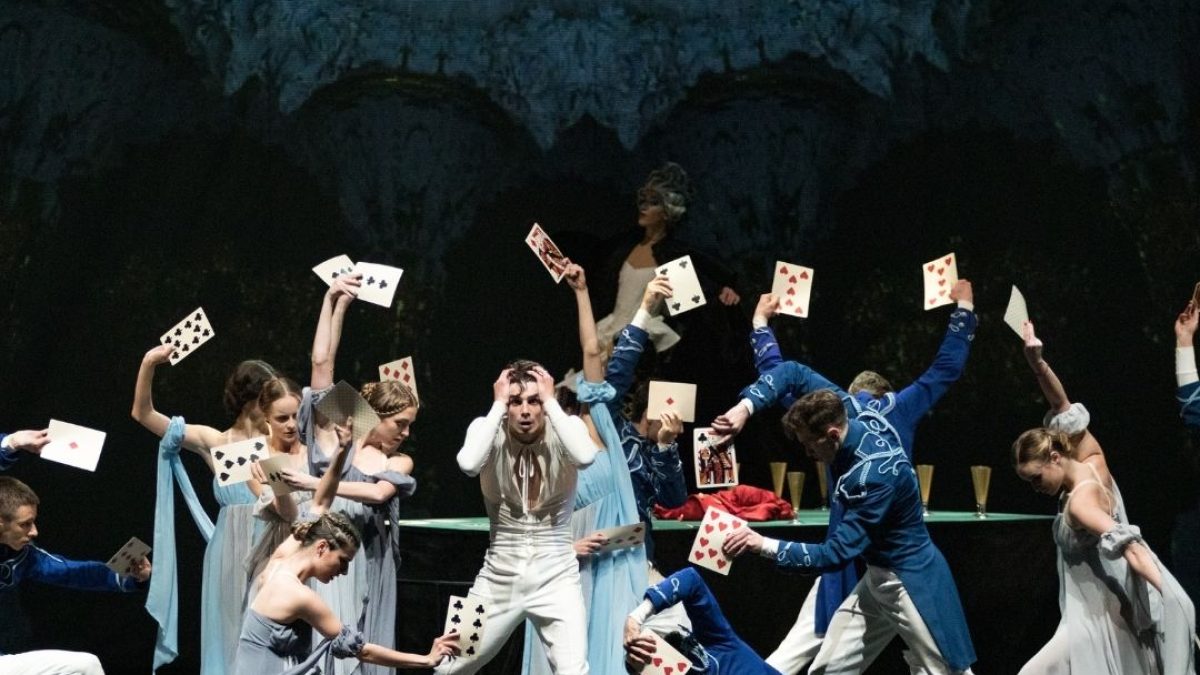
Focus attended the premiere of Radu Poklitaru’s mystical-erotic ballet based on Alexander Pushkin’s “The Queen of Spades”, which has a completely different plot.
Focus attended the premiere of Radu Poklitaru’s mystical-erotic ballet based on Alexander Pushkin’s “The Queen of Spades,” which has an entirely different plot.
Before the premiere of Radu Poklitaru’s Kyiv Modern Ballet at the “Zhovtnevyi,” a considerable number of executive-class foreign cars was striking: Bentleys, Mercedes, Lexuses. With their enormous bodies they filled the entire space in front of the building, flashing their headlights and barely finding spots to park. They say the portrait of the Maestro’s core fan is a well-to-do woman aged 35+. With a husband, of course: hence the whole motor fleet.
Radu’s latest ballet premiere did not disappoint expectations – it turned out to be a grand show with various marvels and surprises (budget of 2 million hryvnias).
Tchaikovsky… but not that one
Before the premiere, Radu Poklitaru travelled to the estate in Kamianka, where two of the three authors of “The Queen of Spades” ballet — Alexander Pushkin and Pyotr Tchaikovsky — had stayed. But for the ballet Poklitaru uses not the music of Tchaikovsky’s opera “The Queen of Spades,” but his Second (“Ukrainian”) Symphony, written in Kamianka, and the composer’s programmatic Sixth (“Pathétique”), presented to the public a month before his death. In a dramaturgical sense, Poklitaru is a co-author of these two creators, because he reworked the plot, beginning with the fact that the first part of the ballet is a detailed history of the relationship between the Countess and Saint-Germain, which does not exist in Pushkin.
Let us recall the plot of the classic novella of 1834 — the first work of Slavic literature to become popular in Europe. A German military engineer by the surname of Hermann lives in Petersburg. He has heard that an elderly countess knows the secret of winning cards in the game of faro. He courts her ward Liza in order to get closer to the old woman, and, threatening her with a pistol, tries to extract the secret. But the old lady has a heart attack from fright and dies. Already in the guise of a ghost, she appears to the engineer in a dream and reveals the cherished cards — the three, the seven, the ace — while setting a condition: Hermann must marry Liza. Twice Hermann wins, but he does not marry the ward. With such money! However, on the third time the ace turns into the queen of spades, Hermann is ruined and ends up in a madhouse.
The plot was suggested to Pushkin by his friend, Prince Sergei Golitsyn. Once he lost at cards and in despair rushed to his grandmother Natalya Petrovna begging for help, knowing that she was aware of the winning cards from her French friend, Count Saint-Germain. Having learned the secret, he supposedly won his money back.
The dark mage Saint-Germain
Poklitaru took only the common plot outline. In Pushkin’s novella there are literally a few sentences about the adventurer, alchemist and occultist Saint-Germain. But in the ballet this suspicious character is one of the main protagonists, so he is played by principal dancer Artem Shoshin.
As always, in Poklitaru’s production a special place is given to metaphors and transformations. There are two key objects in the ballet. The first is a gaming table covered with green cloth, which often transforms into a bed. Explicit scenes will regularly take place on it. The table combines two passions — for cards and for love. Moreover, the Countess also has a green dress the colour of gaming tables; she is Miss Gamble. The second object is a four-metre mirror, which is a portal into another reality, where we see otherworldly images shown by means of special glass and digital technologies.
Saint-Germain is dressed in a sumptuous violet doublet — he is the master of the French people’s minds, a dark mage, and the charming Russian Countess falls within his field of vision. At Versailles, noble cavaliers in wigs and breeches lead round dances around her. The Countess is light, graceful and lucky at play (the role is performed by prima ballerina Olena Saltykova). Saint-Germain becomes increasingly insistent and gives the beauty an expensive necklace. The girl accepts the gift, but rebuffs the cavalier — if you’re going to be capricious, then be capricious!
However, at the next game she loses everything and gives herself to Saint-Germain on the table-bed, where she extracts the secret of the Three, the Seven, the Ace (performed by Anastasia Dobrovolska, Daria Herashchenko, Illia Miroshnichenko). The Countess, riding these three cards with the topical faces of Jokers, once again finds herself at the gaming table and sweeps the pot. Television cameras transmitted the image of the cards onto the screen during the game — the audience saw the real layouts.
Love will come unawares
The action of the second part of the ballet takes place in nineteenth-century Petersburg. Hermann (Vladyslav Detiuchenko) is playing. Someone has lost and ends his life by suicide. The engineer sees the old Countess with her young ward Liza (Kateryna Kuznetsova). Through Liza he tries to get closer to the old woman in order to learn the secret of the winning cards. And all of this is watched by the “eternal” Saint-Germain.
An interesting moment: when the elderly Countess looks into the mirror, she sees herself as the young Liza. But then she turns back into the Old Woman: the digital mirror to the rescue.
Hermann frightens the Countess with a pistol, she dies, but soon appears as a phantom and beautiful once more. The Countess passes the secret of the three cards to Hermann, and a love duet arises between them. Somehow the German engineer has appealed to the desperate Miss Gamble.
As for the dance of Hermann and the Three Cards, it is the finest choreographic number of the ballet: the Gambler whirled, soared and literally revelled in his all-powerful Three Jokers. And all this took place against the backdrop of swirls of cards on the screen.
The Queen of Spades: the reckoning
Hermann’s opponent at the gaming table is Saint-Germain. Twice the engineer wins, on the third – fiasco. He has gone mad and ends up in a madhouse.
Here the most enigmatic thing in this ballet takes place: the Countess and Saint-Germain emerge from the mirror and make love in the presence of the failed gambler. And then the Countess, tenderly bidding Hermann farewell, kisses him. The motives of these processes are not very clear. Here the storyline of Liza’s marriage has effectively been removed. So who is taking revenge on whom, and for what? Let us sort it out.
The dark sorcerer was in love with the Countess, which is why he watches over her in Petersburg. But, while arranging Liza’s future, the Countess herself falls in love with the ardent Hermann — in essence he is just as much of a passionate gambler as she, and just as much a victim of Saint-Germain’s power. The Countess appears to the engineer in a dream as she once was — young and charming. Her feelings for Hermann have rejuvenated Miss Gamble, and he too is not indifferent to her. This does not suit Saint-Germain. Jealousy compels the mage to become Hermann’s rival in the card game — his very rival in love. And vindictiveness compels him to appear through the mirror-portal in the madhouse together with the Countess and to make love with her in the presence of the engineer, in order to prove to the latter that this is his woman, his property!
But is he truly capable of subjugating a woman’s heart forever? The Countess is wilful! Like Helen of Troy, who, being the wife of the mighty king of Sparta Menelaus, fell in love with a handsome prince from Troy, Paris. That is why the Countess rewards the engineer with a farewell kiss. And the dark mage, who subjugates the game, time and space, proves powerless over the Countess’s new feeling. The treacherous triumph over Hermann turns into a defeat for Saint-Germain: in this love triangle Miss Gamble gave her preference not to the sorcerer’s side.
The formula of the production: a passionate gambler – falling into the clutches of the devil – an attempt at salvation through love. By the way, Liza came to visit Hermann in the madhouse, but realised that she would be unable to help him in any way.
The Countess is the central character of the ballet, the one who binds together all the heroes of this mystical-erotic production. And since the love triangle is in the foreground here, the storyline of Liza’s marriage has been left entirely outside the brackets of this story.
An unexpected interpretation of Pushkin’s novella.
In the director’s place, I would have made the ballet’s core storyline more distinct: it is blurred by a multitude of actions of secondary characters.
Kostiantyn RYLOV