“1984. Another”. The dystopian ballet’s choreographers on Orwell’s original and correspondence with the composer of “Joker”
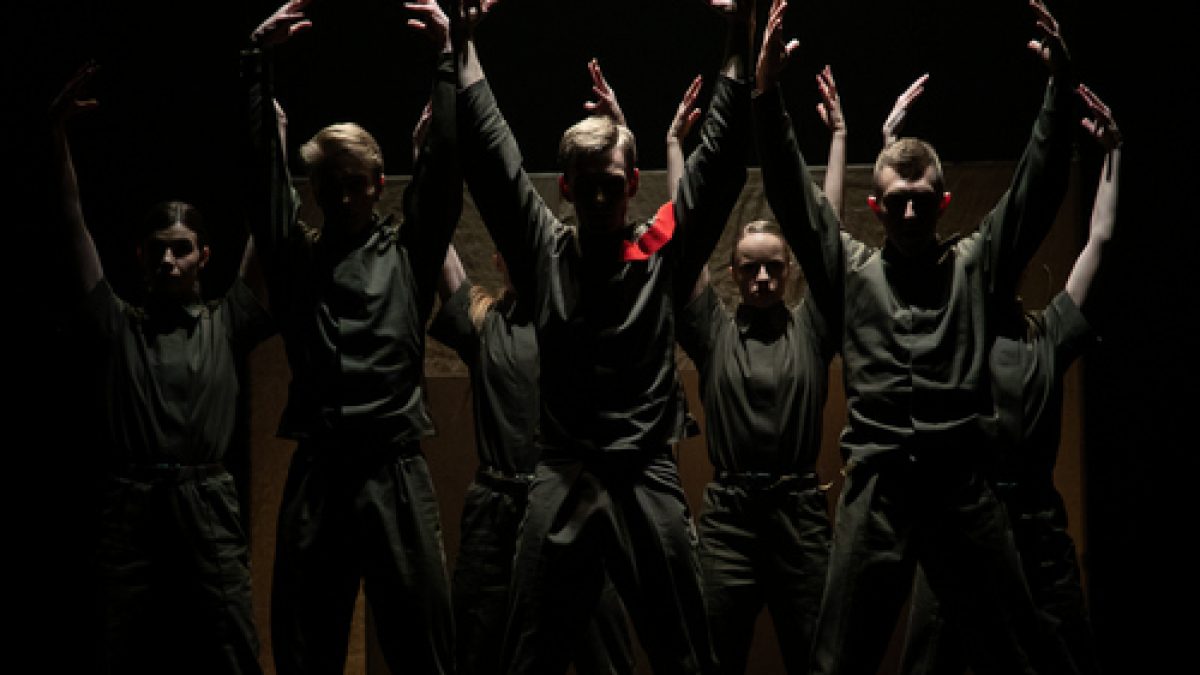
In the 40-minute one-act ballet staged by “Kyiv Modern Ballet” artists Illia Miroshnichenko and Kateryna Kuznetsova, on a stage with laconic moving sets, nine dancers told the story of a totalitarian society through their movements…
Last week, the stage of the Kyiv Academic Opera and Ballet Theatre hosted the first-ever performance of the dystopian ballet "1984. The Other," based on the novel by British writer George Orwell.
In this 40-minute, one-act ballet, staged by Kyiv Modern Ballet academic theatre artists Illia Miroshnichenko and Kateryna Kuznetsova, nine dancers told the story of a totalitarian society through their movements on a stage with spare, mobile sets. Dressed in identical, nondescript costumes resembling uniforms, they moved among walls of paper, chains and metal mesh.
As the musical accompaniment for their dystopian production, the choreographers chose works by composers well known to film buffs — Icelandic cellist Hildur Guðnadóttir (Joker, Chernobyl) and German pianist Hauschka (Lion, Patrick Melrose). Their music complemented the image of the oppressive, captive, controlled world created on stage.
NV STYLE spoke with the choreographers of the ballet "1984. The Other," Illia Miroshnichenko and Kateryna Kuznetsova, about the inspiration drawn from Orwell, the music of the Oscar-winning composer, and the unusual choice of the production’s principal antagonist.
How did you come up with the idea of shaping Orwell’s story into dance? Had you seen other theatrical or film adaptations of this material?
Illia Miroshnichenko: The idea came about by chance. On our way to rehearsal, we were talking about literary works and themes relevant to our times. My colleague Katia Kuznetsova mentioned two dystopian novels — Orwell’s "1984" and Huxley’s "Brave New World." I heard the word dystopia and realized it was an interesting subject for a ballet. We chose Orwell because his concept seems closer to our audience than Huxley’s vision of dystopia.
We deliberately avoided watching theatrical productions, so as to create our own in a kind of directorial vacuum, free from the influence of other ideas. We did, however, watch the film "1984," and that made it easier to write our own libretto for the production. There we saw a rather powerful gesture of belonging to the Party, and we decided to keep it in our work.
Kateryna Kuznetsova: I first encountered "1984" in my third year at the institute. For me, this work made it onto my list of landmark books. So it was no coincidence that, when the question of an idea for a new production arose, it was Orwell’s novel that came to mind.
What was the most difficult part of creating the ballet "1984.The Other"? Did any creative disputes arise between you?
Illia Miroshnichenko: The hardest part, oddly enough, was not staging dry choreography, but building a sequence of dramatic scenes. First of all, the novel’s main plot, in our opinion, cannot be staged in the format of physical theatre. It is precisely the kind of work that can exist only in the original. A very similar case is the film The Truman Show, where the protagonist’s life is a utopia of his inner world and turns out to be one continuous deception. That story cannot be staged in the theatre. That was the first challenge of our production.
So we decided that we had no right to spoil the original novel, and we made the decision to use Orwell’s concepts and structures and to stage a story that could unfold in parallel with the life of Winston Smith.
Understanding the author’s idea of the boundless power and influence of the Party, we decided to make stage light the production’s principal antagonist. Accordingly, we depicted the nonexistent Big Brother through a shadow on the screen.
The heroine is, from the very beginning of the production, the Other. She is blind, the Light has no effect on her, the Party does not exist for her. And that means that to everyone she is merely an object of mockery.
The protagonist is an idealist, a fanatic of the Party with an implacable craving to swallow ever more happiness-pills bestowed by the system. As a result, he loses his hearing, becomes Other, and destroys his own ideals. After that, everything follows Orwell: doubt in the existence of Big Brother, acknowledgement of his own insignificance, rejection of the system, and betrayal.
Kateryna Kuznetsova: I assessed the scenes we staged more from the emotional side. For instance, whether I understood what our characters were feeling, whether there was enough tension and build-up in their emotions for those feelings to carry over to me as a viewer, and so on. Illia, on the other hand, was more responsible for the picture from the other, visual side. It was important to him to find an unconventional and interesting solution in the choreography, an interesting way of presenting the material. So it seems to me that, by combining our two focuses of attention, we sought consensus more than we argued.
Hildur Guðnadóttir recently became the sensation of the Golden Globes. Long before that, you had announced that you were staging your work to the music of the Joker composer. What is the story behind that choice?
Illia Miroshnichenko: We are constantly searching for interesting music, since it is sometimes the very source of inspiration. After watching the second episode of the series Chernobyl, we grew curious about who had composed that unusually atmospheric music. Having listened to several albums by the Icelander Hildur Guðnadóttir, we immediately decided that we absolutely had to stage something to this music. And so the production "1984. The Other" was born. We corresponded with Hildur and obtained her permission to use the music.
What are the choreographers trying to say to the audience by depriving the heroine of her sight?
Illia Miroshnichenko: The heroine is not simply blind; above all she is an image of the unbowed people, the people inconvenient to the Party. We named her the Other in order to give people hope.
Radu Poklitaru, the founder of Kyiv Modern Ballet, stands first on the list of people you thank for their support in creating the ballet. How exactly did the choreographer help you?
Kateryna Kuznetsova: Radu is always open to his artists’ creative impulses. If Radu “gives his blessing,” it means he believes it will be interesting to the audience, that we will manage it. Radu made a very significant contribution to the very title of our production. At first, knowing that we were taking the novel only as an idea, we wanted to call the production simply The Other. But Radu convinced us that we could not leave unsaid that our libretto was based on such a well-known work. So we named the ballet "1984. The Other." The finale of our production also became what the audience saw thanks to Radu.
Illia Miroshnichenko: It would not be enough to say that the chance to release our own work on the Kyiv Modern Ballet stage is the only reason to thank Radu Poklitaru. While working on the production, we realized that Radu was communicating with us as colleagues — that is incredibly motivating. And of course, his advice only strengthened the production that the audience saw.
Maria Kabatsii